
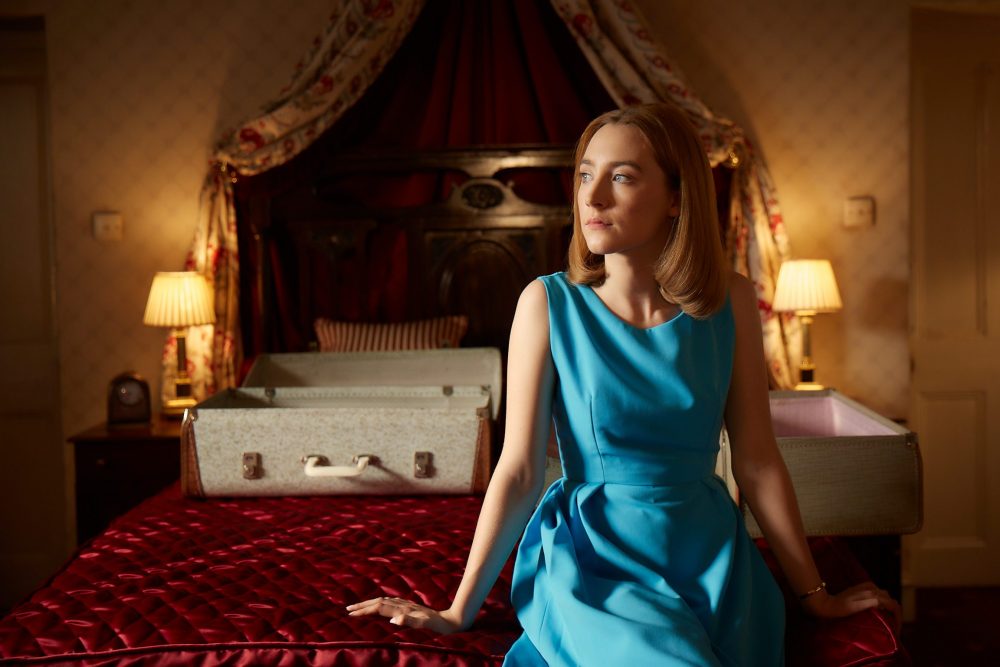
A poignant drama starring Saoirse Ronan looks at female sexuality before the gender revolution.
It’s not often that we see mainstream movies in which young heterosexual lovers completely and utterly fail to connect in the way that society expects them to.
British novelist Ian McEwan’s On Chesil Beach takes as its subject a young and mismatched pair and follows their courtship through 1962, to their disastrous wedding night in a stuffy beachside hotel, and traces the tragic fallout from their ultimate lack of compatibility.
Set in an England stifled by class conventions and rigid gender roles, Florence (Saoirse Ronan) and Edward (Billy Howle) meet through a left-wing university group and we follow what seems to be an idyllic if polite courtship. They mostly behave in the way that young lovers of that era were supposed to, and yet something about them is off; they are cursed by an inability to connect physically or establish deep romantic intimacy.
Edward, a history student, is awkward and prone to angry outbursts. Florence, an ethereal and ambitious violinist, is acutely sensitive to the sensory world. She is physically repulsed by all aspects of sex, especially the mechanics of heterosexual intercourse, the details of which she reads about in horror from a sex manual of the day.
In another era—post-compulsory heterosexuality—Florence may well have been asexual or queer, exploring other forms of corporeal pleasure more suited to her temperament. But this being pre-sexual revolution England, her options are severely limited. Edward, frustrated by his new bride’s lack of willingness to behave like a bride, explodes—physically and emotionally.
He accuses her of being “a bitch” and “frigid.” But is she? And what will happen to the love they feel for each other now that the physical aspect is subtracted?
In their fateful argument on Chesil Beach, Florence barters with Edward, offering to negotiate an alternative arrangement—even citing a gay couple that she knows as exemplars of unconventionality. Edward furiously rejects the suggestion that they live like a “couple of old queers.” And yet, 10 years later, society has loosened its conventions, London is swinging, and all sorts of relationships and living arrangements are permitted.
This particular failed relationship is poignant in the sense that this young couple completely mishandled the conflict they found themselves in; they panicked when things didn’t unfold in storybook fashion. One of them recovers. The other doesn’t. Neither escapes the pain of it all.
Adapted by Ian McEwan to the screen from his novella, On Chesil Beach is a haunting exploration of how desire plays a role in the formation of self—but how society always intrudes in the formation of desire. The supporting cast is excellent, including Emily Watson as Florence’s mother who instinctively understands that her daughter is marrying beneath her; and Anne-Marie Duff as Edward’s brain-damaged but brilliant painter mother.
Florence’s empathy for her inspires Edward’s father to urge his son to “marry that girl.” But it’s not that simple. This is one time in which heterosexuality as a command performance fails miserably.
Produced by Elizabeth Karlsen (who brought us Carol), On Chesil Beach is meticulously realized and Karlsen enthusiastically spearheaded the project, which she saw as “a portrayal of a young woman at a particular time in history and how that defines her creative ambitions, her sexual being, her sense of self,” she explains.
And in a way, it has something in common with Carol: the idea of thwarted desire in a time when women were not allowed to be themselves. Karlsen and director Dominic Cooke wanted one person for Florence, and that was Saoirse Ronan.
And Ronan is stunning as Florence. Simultaneously fierce and delicate, she is the embodiment of a young woman who navigates the traps of heterosexuality—without a feminist slogan or women’s group in sight, and nevertheless forges her own rocky path to having it all. Edward does not fare quite as well as Florence and in this way we see how class—as much, if not more so than gender—can be a ceiling of its own.