
Curve’s Founder and Publisher Franco Stevens (@francostevens)reveals some findings from the
pioneering annual survey for queer women and nonbinary people, and explains why the project is so important.
Download the survey report here,
I awkwardly slid down the gynecologist’s exam table and put my feet in the stirrups. My longtime doctor had moved out of state, and this was my first visit with someone new who was recommended by a friend. As the doctor began the exam, she asked about my sexual activity, using he/him pronouns for my partner. This wasn’t decades ago. It was recent and it was in California. Her assumption that I was straight immediately put me on edge and I ended up coming out to her while in mid-papsmear. The questions that followed focused on my gender identity and the last time I had sex with a man. By the end of the appointment, I wanted to crawl under a rock and never see another gynecologist again. And I’m far from the only one who feels this way.
At the beginning of the year, we asked you to complete the third annual survey we host, in partnership with DIVA magazine and Kantar, one of the world’s largest research companies. We’ve been tracking our community’s feelings about safety and belonging through the survey, and each year we add questions based on the theme of that year’s Lesbian Visibility Week, as the survey report is made public during that week each April. This year’s Lesbian Visibility Week theme was health and well-being.
SURPRISING RESULTS?
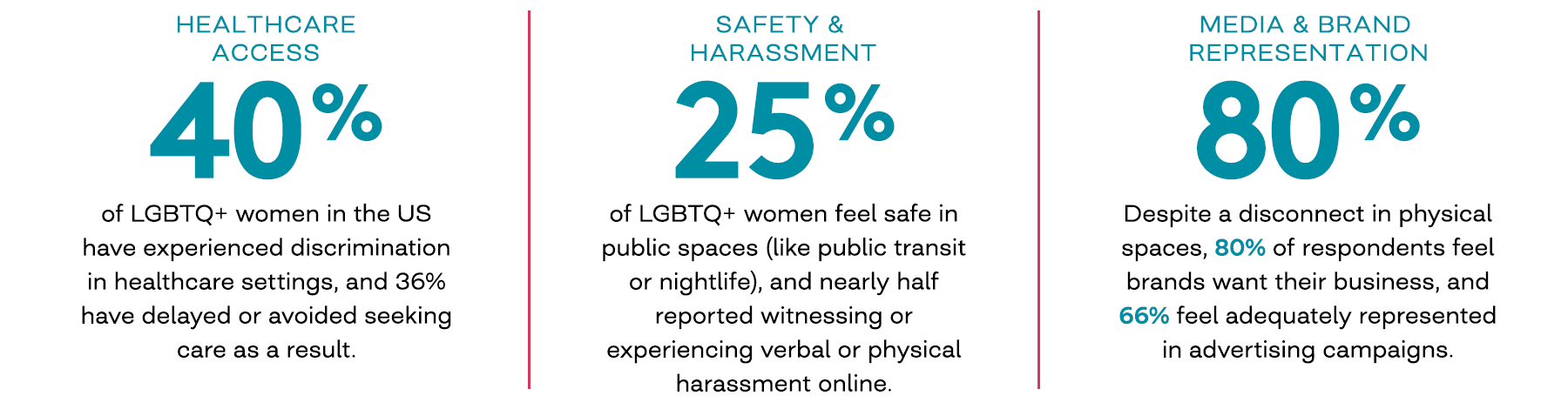
So, what did we discover from this year’s 3,200+ international responses? Nearly 40% of U.S. LGBTQ+ women and nonbinary people reported having delayed or avoided medical care because they feared discrimination. That’s not an isolated problem. This is a systemic disaster.
After the results went live, a reporter asked me whether the data surprised me. Sadly, I wasn’t surprised. The report provides evidence of what I personally experienced and what we, at Curve, have been hearing for years. So, I’m not surprised, but I am upset. The lack of training by medical schools and the absence of attention to queer women’s mental and physical health are staggering. We are essentially flying blind in a medical system that doesn’t care to learn about us.
OUR SAFETY IN PUBLIC PLACES
It’s increasingly tough to be LGBTQ+ in America, and the survey numbers confirm that. 75% of U.S. respondents said they do not feel completely safe in everyday public spaces. Think about that for a moment. Three out of four people in our community are navigating daily life with a heightened unease in their surroundings. Whether we’re riding public transit, stopping for coffee, meeting friends for dinner, or walking down the street, too many of us are quietly calculating risks and wondering if we’ll be judged, harassed, or harmed simply for existing in public spaces.
THE FAMILIES WE DON’T SEE
For decades, mainstream media has painted a very narrow picture of what LGBTQ+ families look like. Our survey tells a different story. Black, Indigenous, and Latinx respondents were the most likely to be raising children, yet their experiences remain largely overlooked. An overwhelming 87% of U.S. respondents said acceptance of their families is often conditional, shaped by both race and sexual orientation. While these communities are helping to raise the next generation, many are navigating systems designed to exclude them.
BIG TAKEAWAYS
When we partnered with DIVA and Kantar to create this survey, our goal wasn’t simply to collect data. We wanted to better understand the realities of our community and put real numbers behind our experiences.
The results confirm what so many of us already know. The challenges we face in doctors’ offices, in public spaces, and in our daily lives are not isolated incidents. They reflect larger systems that continue to fall short of serving our community.
If there’s one thing I hope people take away from this report, it’s that visibility alone is not enough. We need healthcare that affirms us, communities where we feel safe, and policies that protect our families. We deserve more than acceptance when it’s convenient. We deserve the freedom to live openly, love openly, and move through the world without fear.
WHERE TO GO FROM HERE?
At The Curve Foundation, we believe visibility is only the beginning. Our work is focused on making sure LGBTQ+ women and nonbinary people have access to community, our history, and the resources we need to thrive.
That’s why we’re hosting conversations that matter, including our recent panel, Beyond the Rainbow: Health Equity for Lesbian and Queer Women. If you missed it, I encourage you to watch the discussion and subscribe to The Curve Foundation’s new YouTube channel for future programs and conversations.
And if you’re looking for LGBTQ+-affirming healthcare, GLMA: Health Professionals Advancing LGBTQ+ Equality offers a nationwide directory of providers committed to delivering respectful, inclusive care. Finding the right doctor shouldn’t require having to explain or defend who you are.
Watch Beyond the Rainbow: Health Equity for Lesbian and Queer Women.
Subscribe to The Curve Foundation YouTube Channel.
Find an LGBTQ+-affirming healthcare provider through GLMA.
Researchers can discover funding through GLMA’s Lesbian Health Fund (LHF) to
support scientific studies focused on the unique medical needs of LGBTQ+ women
and girls.
Download the survey report here:
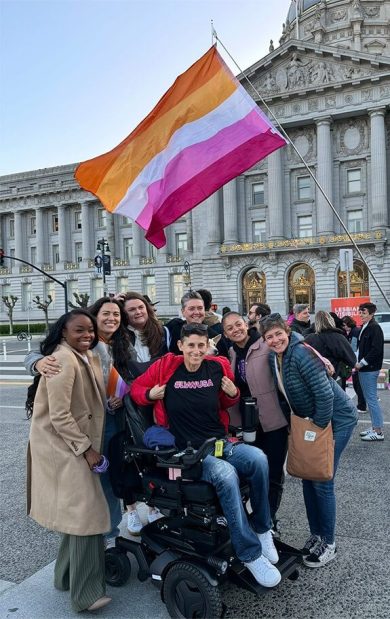
ILLUMINATION OF SAN FRANCISCO CITY HALL,
LESBIAN VISIBILITY WEEK 2025