

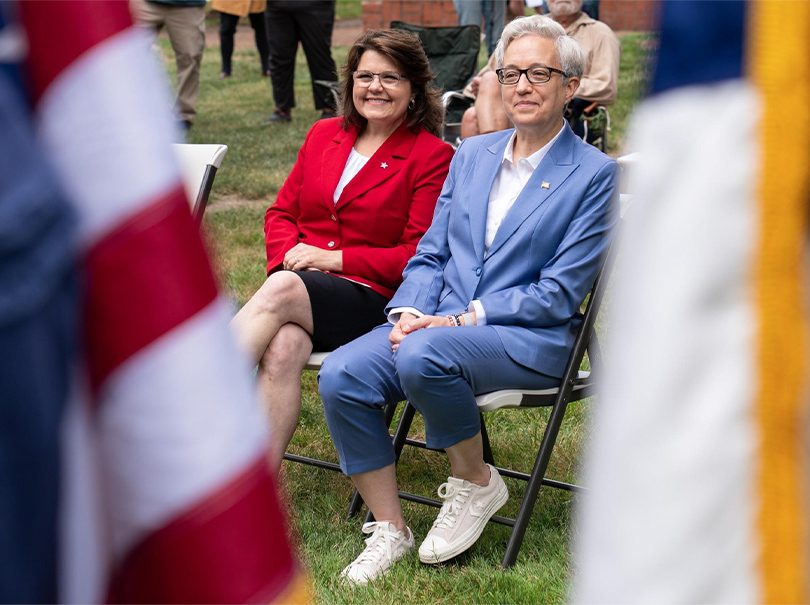
AIMEE KOTEK WILSON AND TINA KOTEK ON JULY 4
CREDIT: STATE OF OREGON
In 2022, Tina Kotek became the first openly lesbian governor (along with Maura Healey of Massachusetts) elected in the United States among a record number of women elected as state executives. Those leaders took the helm at a historic but challenging time in American politics—states were still navigating the collateral damage brought on by the coronavirus pandemic, anti-LGBTQ+ legislation was at a record high, and federal abortion protections were recently dismantled by the United States Supreme Court.
As governor of Oregon, Kotek vowed to visit all 36 counties in the state.
For the governor and her wife, First Lady Aimee Kotek Wilson, it was important for the first same-sex couple to occupy the governor’s residence in Mahonia Hall, Salem, and to be visible – both in progressive Portland and in rural counties where families like theirs may be fewer and farther between.
Kotek Wilson said that some meetings began with “frost in the room.” But when they were able to speak to their skeptics, they often found that human experiences helped them find common ground.
“Pretty soon, they have a story about, you know, maybe they have a daughter who has an addiction, or they have somebody in their family who struggles with autism, and we can really connect over some of these core issues,” Kotek Wilson said.
“We need to reach out, we need to be out, we need to be courageous, we need to be seen—because that is how we are going to change hearts and minds,” she continued.
“You cannot underestimate how
important it is to be yourself publicly, and what that means for other folks”
During her first term, Kotek’s challenges have yet to cease. In addition to the state’s chronic affordable housing problem, much of the governor’s first term has been necessarily devoted to staving off the various attacks by the Trump administration on vulnerable populations, including LGBTQ+ people.
Often, families approach her to say they moved to Oregon because they wanted a safer place for their transgender children.
She hopes that leading the state as an openly queer person helps them feel at home.
“You have to be accessible and normalizing it. When I was first coming out, just being out was a political statement. And because we all benefit from all those folks who came before us, who came out and, you know, were just courageous… you cannot underestimate how important it is to be yourself publicly, and what that means for other folks,” the governor said.

TINA KOTEK AND CONSTITUENT
CREDIT: STATE OF OREGON
THE OREGON TRAIL
Much like those seeking refuge in Oregon now, Kotek’s own story in the state she would eventually govern began with her longing to live in a place where she could be herself.
After growing up in a middle-class family in York, Pennsylvania, Kotek had dropped out of Georgetown University, was in the midst of coming out, and felt that she needed to uproot her life to a place where she could “just be who I needed to be.”
So, in 1987, she moved to Oregon and fell in love with the state. She went back to school, finished her degree at the University of Oregon, and has been on the West Coast ever since.
“I think for me, the journey of coming out and just figuring out who you are also coincided with physically moving to a place that could support that,” Kotek said.
After a stint in Washington state for graduate school, Kotek began her career in public policy with Oregon Food Bank, advocating in Salem for policies to reduce food insecurity, including a strong minimum wage, affordable housing, access to health insurance, and improvements to the state’s food stamp program.
Advocacy also brought Kotek Wilson to Oregon for a farmworker housing internship after growing up in Arizona. “I knew of Tina before I met Tina, and that was because she had earned the respect of my members,” she said. The pair eventually met working on issues related to poverty and food security.
Kotek never expected to run for office. After working as an advocate, friends encouraged her to seek an open seat in the Oregon House of Representatives. She lost in 2004 but won a few years later, winning the seat she would hold for almost 15 years.

TINA KOTEK WITH AIMEE KOTEK WILSON
CREDIT: TINA FOR OREGON
DEFINING ISSUES
Kotek’s first year in the Oregon legislature in 2007 was also a pivotal time for LGBTQ rights in the state.
That year, lawmakers enacted legislation adding sexual orientation and gender identity to the state’s anti-discrimination laws and establishing domestic partnership rights. At the time, the legislation was almost unheard of.
The couple sat on the House floor together while the legislation was being debated.
“We were the only family that looked like us, and for some of those legislators, we were probably the first LGBT family they knew personally. So it was really important for us to represent,” Kotek Wilson said, adding that now, there is an entire caucus of LGBTQ legislators in the Oregon legislature.
Kotek held her House seat from 2007 to 2022, eventually becoming the longest-serving House Speaker in the state’s history. In 2022, she set her sights on the governor’s office.
Throughout her political career, the issue that has been a throughline has been addressing the state’s chronic affordable housing problem. The issue dates back to her days at Oregon Food Bank. By the latter half of her legislative career, she said, Oregon’s shortage of affordable homes, rising rents and growing homelessness had become impossible to ignore.
“What I was noticing was housing was not available, it wasn’t affordable, rents were too high,” Kotek said. “The Great Recession really exacerbated that, and I saw how people were suffering.”
Housing remains a persistent issue in the state, one that she argues hits vulnerable populations especially hard, including LGBTQ youth, seniors and communities of color.
“We know from our personal experience that when you are marginalized because of who you are, you need other people to rally around you, make sure the systems work better for you,” Kotek said.
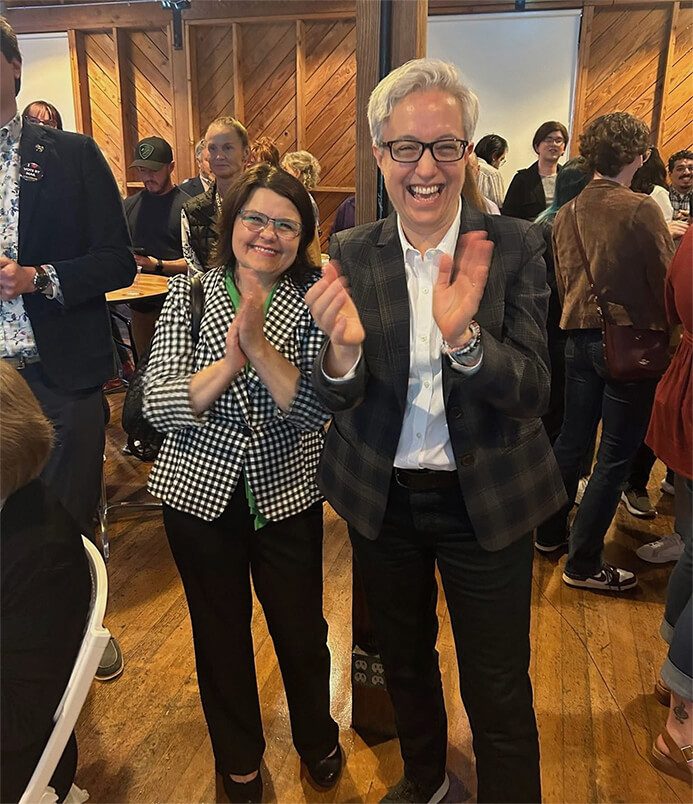
CREDIT: TINA FOR OREGON
LEAVING OREGON STRONGER
As she looks ahead and hopes to earn a second term this year, Kotek says her work protecting LGBTQ Oregonians isn’t finished.
“Oregon is a purple state. … Everything we have is always a little tenuous,” she said.
As governor, much of her focus has been devoted to protecting transgender Oregonians and preserving access to gender-affirming care, which she said has come under increasing attack from the Trump administration.
“The way the Trump administration is coming after the trans community, we’ve all been there,” she said. “This is that next level of the fight.”
Kotek said Oregon has enacted protections for healthcare providers who offer gender-affirming and reproductive healthcare and has sought to preserve access to those services despite legal and political challenges from outside the state.
“It is a daily exercise of not going backwards,” she said.
“You don’t get to bully and terrorize this community for your own political agenda. We will stand together to defend them.”

ABOUT THE AUTHOR
Mary Frances McGowan is a recipient of the 2025-2026 Curve Fellowship for Emerging Journalists. She is currently a reporter for her hometown paper, Cleveland.com/The Plain Dealer, where she covers politics and policy battles at the Ohio General Assembly. Prior to joining the team in 2025, she was a staff correspondent at National Journal in Washington, DC, where she covered political campaigns for all 50 U.S. governors, state legislatures, and state legislative policy. She has also worked for NBC News, both as Tim Russert Fellow for Meet the Press and as a researcher for the Washington bureau. McGowan has also been published by the University of Virginia Center for Politics as a contributor to their books detailing the 2020, 2022, and 2024 elections. She is a proud graduate of John Carroll University, where she studied political science and journalism.