

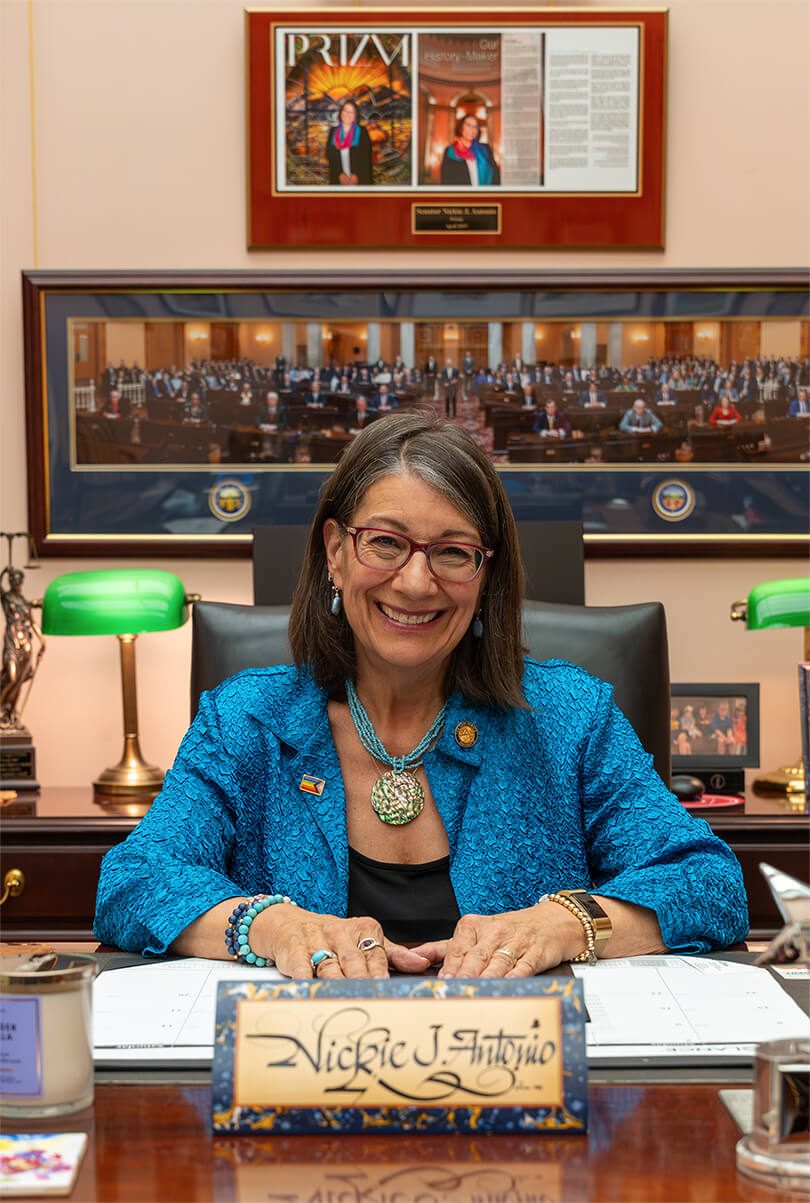
PHOTO CREDIT: THE OHIO SENATE DEMOCRATIC CAUCUS
Twelve times in the last sixteen years, Ohio Senate Minority Leader Nickie Antonio has introduced the Ohio Fairness Act. Each time, it has failed.
Despite federal employment protections, LGBTQ+ Ohioans still lack comprehensive statewide civil-rights protections in areas such as housing and public accommodations. Antonio’s legislation wants to change that for Ohioans.
Some may question why Antonio bothers to continually reintroduce a bill that falls on deaf ears in the conservative-leaning Ohio General Assembly. But at a time of unprecedented levels of federal and state legislative attacks on LGBTQ+ people – transgender youth in particular – she says it’s never been more important to continue the conversation and let queer Ohioans know that someone in the statehouse is fighting for them.
Over the course of her decades-long political career, the bill is one of countless fights Antonio has taken on – including fighting for the working class, reproductive rights, adoptees’ rights, and more. But it is perhaps the most illustrative example of her dogged commitment to advocating for her community when she has often been the only LGBTQ+ leader in the room.
At the end of this year, Antonio will be term-limited and will retire from her work at the statehouse, where, sixteen years ago, she became the first openly LGBTQ+ member in the General Assembly’s 208-year history.
For local activists fighting for LGBTQ+ rights and the like-minded lawmakers who came after her, her story has been a “guidepost” on living your life in devotion to one’s community.
“I have an absence of shame,” she said. “I’m proud to be who I am, my authentic self, and bring that to everything that I do.”
“I have an absence of shame. I’m proud to be who I am, my authentic self, and bring that to everything I do.”
EARLY DAYS
Long before Antonio would have to navigate thorny political dynamics at the state capitol, her early life taught her to be tenacious.
“I grew up being told there were things I couldn’t do that I refused to accept that has served me well in the legislature,” Antonio said. “I knew what it was like to feel discriminated against for things totally out of my control, and I had to figure out a way to weave through them.”
After her parents divorced when she was a young girl, Antonio was uprooted from the quiet rural outskirts of Cleveland to the west side of the city.
As she watched her mother navigate their “turbulent” life post-divorce as a single woman in the 1960s, she learned early how the world treated women differently.
Despite working full-time, her mother was unable to get a mortgage on her own without a man co-signing. She was also shunned in a place Antonio thought would embrace them in difficult times her family’s Lutheran Church.
Those early experiences of feeling like an outsider steeled her spine and carried into her teenage years. Determined to get the best education possible despite her family’s limited resources, she put herself through private Lutheran high school, cobbling together the funds from various jobs and a partial scholarship.
When it came time for college, a guidance counselor, aware of her family’s circumstances, said that despite her good grades, her best hope in life would be to become a secretary.
“I went home and said, ‘I’m not listening to that.’ So, there was another sort of marker in having this adult who’s supposed to be an expert in something tell me something that I was going to totally disregard,” Antonio said.
Antonio worked her way through Cleveland State University, earning her bachelor’s degree in education in six years, in 1980- dropping out periodically to work full-time to finance her education.
CHOOSING TO STAY AND FIGHT
Years later, Antonio was living in Lakewood, Ohio a progressive suburb just outside of Cleveland – and raising her daughters with her wife, Jean Kosmac.
The pair was committed to raising Ariel and Stacey with a sense of fairness and justice, attending protests and NOW meetings with their daughters in tow.
Even though Antonio spent her free time as an activist for women’s and LGBTQ+ rights and working on other people’s political campaigns, she thought getting elected herself was out of reach, given that she and Jean were living their lives together so openly.
But things changed in 2004. That year, Ohio was one of thirteen states nationwide to pass a constitutional amendment defining marriage exclusively as a heterosexual union, making same-sex marriages and civil unions unconstitutional.
Antonio said that many of her friends left the state, fearing that their children, or right to adopt, would be taken away. While Antonio understood that, she and Jean wanted to stay and fight. In fact, they would end up waiting over 10 years until marriage was equal for all Ohioans in 2015 before they’d tie the knot themselves.
“We believed that because not everyone could leave, it wasn’t right for us to do that either,” Antonio said. “In the meantime, I got pissed. I was like, nobody tells me I’m a second-class citizen; I work just as hard, they don’t refuse my tax money. Why should I not be a part of every part of this?”
Antonio decided to run for an open seat on Lakewood City Council in 2005 and won. Her years serving her local community gave her the confidence to imagine she could take her political career all the way to the statehouse.
“I talked on the phone with somebody who said the [Ohio House] seat is going to be open, we got to find somebody to run. And he rattled off all these people, and finally I said, ‘Well, what about me?’ And he said, ‘Oh, would you want to do it? And I said, ‘Yeah, I think I do… But now he tells the story always that it was his idea.”
After being reelected to the council in 2009, she ran for the Ohio House of Representatives the following year, defeating the favored pick in the primary and winning the general election in 2010, becoming the first member of the LGBTQ+ community ever elected to the Ohio legislature.
“When you’re the first, you don’t ever want to be the last.”
THE IMPORTANCE OF BEING IN THE ROOM
Antonio said she felt the weight of being the first openly LGBTQ+ member even before she won the election.
“It felt like a lot of responsibility, honestly. I mean, it still feels like a lot of responsibility, because when you’re the first, you don’t ever want to be the last,” she said.
When she first arrived at the statehouse, she said, being openly gay made her something of a novelty. There were disagreements over LGBTQ+ issues, but they were not yet a central focus of legislative battles. But the political atmosphere in Columbus changed after the U.S. Supreme Court’s 2015 Obergefell decision that legalized same-sex marriage nationwide, Antonio said. As marriage equality became settled law, she began to see a growing backlash. National organizations circulated model legislation across statehouses, and some lawmakers arrived in Columbus determined to push restrictions aimed at LGBTQ+ people, particularly transgender Ohioans.
“There was definitely a backlash,” Antonio said. “It’s just continued.”
That shift helped transform LGBTQ+ rights into one of the Ohio legislature’s most persistent battlegrounds.
However, there are some reasons for hope. In her sixteen years at the Statehouse, relatively few anti-LGBTQ+ measures have ultimately become law. She credits that largely to Ohio’s LGBTQ+ advocacy network, which routinely mobilizes across the state to testify, lobby lawmakers and educate the public.
Antonio also believes representation inside the legislature matters. Being in the room, she said, has allowed her to pull colleagues aside and explain the human consequences of legislation.
“Sometimes the answer was, ‘I had no idea. I thought I was protecting a different group of people. I never thought about the consequence,” Antonio said. “Okay, well, let me tell you what it is.”
Those conversations, she said, are only possible because she has spent years building relationships with lawmakers across the political spectrum.
Guided by a spiritual belief in the dignity of every person, she said she makes a conscious effort to see the humanity in colleagues who may strongly oppose her on LGBTQ+ issues. It is not always easy, she said, but it is part of the example she wants to set for her family, constituents and the next generation of leaders.
LEAVING IT BETTER THAN YOU FOUND IT
For many Ohio LGBTQ advocates, Antonio’s career has been a blueprint.
Dwayne Steward, executive director of Equality Ohio, describes Antonio’s two decades in public life as a “guidepost” for LGBTQ+ Ohioans. Having an openly LGBTQ+ lawmaker at the Statehouse, he said, ensures legislators cannot debate issues affecting the community without confronting the people those policies impact.
“I truly believe that nothing without us is for us,” Steward said.
That presence has been especially important as Ohio has seen a wave of legislation targeting LGBTQ people, particularly transgender youth. Steward said Antonio has served as both a voice inside the legislature and as a visible reminder to LGBTQ+ Ohioans that someone is fighting for them.
Even when the Ohio Fairness Act failed to advance, its impact stretched beyond the Statehouse. Steward said communities across Ohio used the bill as a model for local anti-discrimination ordinances. Today, 37 Ohio cities have protections mirroring Antonio’s statewide legislation.
“People have taken that language and used it to pass local measures,” Steward said. “That work was forged by Sen. Antonio.”
Steward believes Antonio’s larger legacy is showing that LGBTQ+ issues are Ohio issues, and that LGBTQ+ leaders belong in positions of power. By fighting not only for LGBTQ+ rights but also for workers, families and other causes, she demonstrated that queer lawmakers could lead on every issue facing the state.
“She’s trailblazed a pathway for other LGBTQ+ electeds to feel like they can do this, that they can serve their community, they can lead their community in this legislative way, when many may not have thought that was possible for them before,” Steward said.
Antonio’s impact can also be seen in the lawmakers who followed her to Columbus.
State Rep. Christine Cockley, one of the legislature’s openly LGBTQ+ members, said Antonio showed her that elected officials do not have to separate their identities from their work.
“One of the things Leader Antonio has taught me is that a legislator can be multi-layered,” Cockley said. “I’m not just Jewish, I’m not just the youngest woman at the Statehouse, I’m not just queer. I am all of those things.”
“I want to be able to say I definitely left it better than I found it.”
Just as importantly, Cockley said, Antonio has a habit of bringing others along.
“In a place like the statehouse, it’s so important that a legislator and a leader lifts people as they lead,” Cockley said. “Leader Antonio does a really good job of that.”
As Antonio prepares to leave office, she said she already sees part of her legacy taking shape in the growing number of LGBTQ+ elected officials across Ohio.
“I guess if anything, my legacy is I want to be able to say, and I think other people to say, I definitely left it better than I found it. And I believe it’s true.”