
PHOTO: MARC MILLMAN
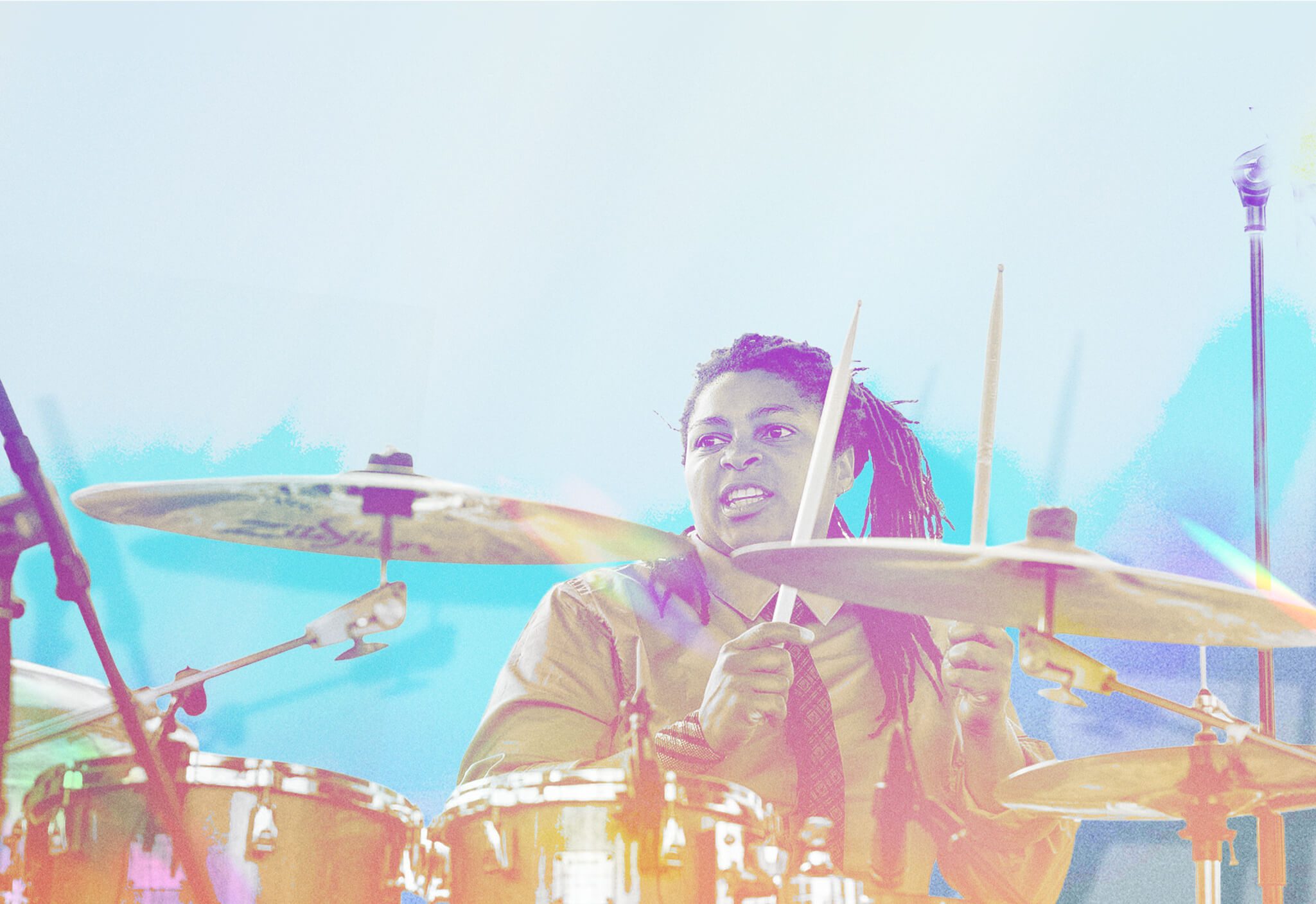
There’s a moment, if you’ve seen Nikki Glaspie play the drums, when you realize how reliant we are on categories and how irrelevant they are. It’s not often we see a Black woman behind an arena-ready drum kit, hitting with maximum, calculated force. Someone in complete command of their instrument, her band, the room. And that’s what makes Glaspie’s story so important. A “pocket” drummer (slang for a drummer who plays a consistent rhythm that sits perfectly within the groove of a song), she is one of the premier drummers in music today.
The drumming world has been tough on women, as statistics show—women represent less than 10 percent of all drummers in the music industry, according to Drumeo. For Black women, that number shrinks further, with the intersection of gender, race, and queerness even more marginal at the professional level.
Glaspie entered that space without apology, determined to build a career at the center of demanding musical environments, whether that meant random low-paid gigs or the jam-band festival circuit. But she wasn’t in it to make money. She was in it to heal people’s lives and to communicate what she knew to be true: that all life begins with a beat.
BORN INTO RHYTHM AND FAITH
Born in Virginia to a family of Black, Southern ministers, Glapsie hit the skins as a toddler. She was two! Her first serious adventure in groove came at age 8, when she held down the rhythm at her church.
“I was in a couple of different denominations. I grew up in the Apostolic Faith, and then when I was about 15, I went to a Baptist church. When I got to college, I played in a Presbyterian church,” she told Curve. But denominations aside, Glaspie talks of holiness alongside all kids of spirituality and mysticism. “I still consider myself a Christian in the sense that I try to be Christ-like. And if you read about the man, you know that he was basically homeless; he hung out with the prostitutes and the lepers and the outcasts of society, and lent a hand. To me, that’s what a real Christian is.”
Glaspie also lived in Maryland and North Carolina, and in her youth watched other drummers and how they set the rhythm and connected with people. Drumming is more than percussion. It’s communication. I suggest to Glaspie that every culture has drums or drumming.
“Man, it comes from our bodies,” she says. “Everyone has rhythm. We have a heartbeat. You know, and if that stops, then we die. And that’s pretty much it.”
But there was much to learn. Glaspie attended a summer program at Berklee College of Music and then enrolled full-time, graduating in 2005. It was a transformative period in which she discovered her influences and built her own musical language. As she learned about ear training and arranging, she drummed at Wally’s, the historic jazz club in Boston’s South End, and began to forge friendships with other musicians.
HER BIG BEYONCÉ BREAK
After leaving Berklee, Glaspie moved to Brooklyn, and, broke—she had about fifty bucks to her name—turned down a paying gig to audition for Beyoncé. She crushed those drums and got the job. “Who is this kid?” Bey was heard to marvel.
And so, Glaspie became the powerful drummer for Sugar Mama, the ensemble of female musicians who toured with Queen Bey around the world, from Saudi Arabia to the White House, with appearances on national TV. Over the next five years, she learned a lot about persistence, professionalism, and pride in herself.
When Glaspie left Beyoncé, she had no clear plan, but soon joined Ivan Neville’s New Orleans Dumpstaphunk. She was inside the biz, playing deep funk in the Big Easy. The fellowship and the chosen family were wonderful. But inequities were there.
“We know that women make less money than men,” says Glaspie. “We have the studies to prove it. And I know it to be true. It’s why I have created my own work and started bands.”
After forming three bands, Glaspie is a natural band leader. A mama bear, a professional driver, a travel agent, a tour manager—all the things it takes to keep a group on the road. “I am a proud card-carrying member of the spreadsheet mafia,” she laughs. “I love a challenge. I’m here for it, you know, I want to be the reason I fail or succeed. I don’t want to fall on somebody else.”
Her main band, The Nth Power, is a funk-soul-jazz outfit that believes in music as a higher power, sexy, spiritual, and transcendental.
PHOTOS: NIKKI GLASPIE
MORE POWER, MORE ROAD AHEAD
The Nth Power released their debut album, Abundance, in 2015 and toured relentlessly in support of it. The band’s catalog, including records such as Reverence, carries a message larger than genre; love, understanding, and human connection are vital. This year, Glaspie released an ambitious, genre-blending outing created in sessions at a remote farmhouse in Vermont at the invitation of Phish bassist Mike Gordon. The Nth Power is touring throughout 2026 to support the album.
“The name of the album is Never Alone,” says Glaspie. “We felt that, especially now with everything going on, people need to know that they’re not alone. We’re all kind of going through this thing together. And it has many meanings: You’re never alone in the spirit world; I believe your ancestors walk with you, and you have people who protect you, even if they’re not here. And we’re also all in this together. The powers that be, the people that are in charge, they do not care about humanity. All they care about is wealth and power, really.
“I’m also feeling hopeful, because I know what we’re trying to do is the same thing, which is spread love and bring people together. I’ve always said that just because we have differences or disagree, it’s not a reason to kill each other.”
Glaspie represents something bigger than an album or a string of them in a brilliant career. It’s a mission, she says. “We are trying to heal and make lives better.”
WHAT DA FUNK? TRANSCENDING LABELS
While there are no hard-and-fast rules in contemporary music, funk is considered to be one of the most fluid and influential genres.
“I love funk because I kind of consider it to be trance music,” Glaspie tells me. “You find one rhythm, and you sit on it, and you keep doing it and keep doing it and keep doing it. And it starts to get a rise out of people, because it starts to get good. There are all sorts of these types of beats, but like a train beat or whatever, it really takes people to a different place where they have to move, they have to dance. And that is the thing that I get joy out of, seeing people move and dance, because dance is a form of happiness.”
Glaspie considers herself a part of the LGBTQ+ community, and if pushed to use a label, she would choose queer.
“I’m fluid, you know, I’ve never been into labels in general. Because I think that it is limiting. It’s like I could be or do whatever I want, you know, so why do I have to say that I’m this or that or make a declaration? I understand why some people have to.”
Glaspie’s been with their current partner for eight years and describes them as her “soul mate.”
“You know, we were definitely together in a previous lifetime. There’s definitely a spiritual connection.”
But as always for Glaspie, it all comes down to one thing: not what’s on the outside, not sexuality or gender. It’s all about that one thing: the beat.
“Like, for real. I don’t care what you have. All I care about is your heart.”
WHAT PEOPLE DON’T UNDERSTAND ABOUT BLACK WOMEN
I wonder why systemic racism and “misogynoir” are still very real in such a capitalized industry where queer Black women have time and again proved their excellence. What is it about Black women that the culture at large gets wrong?
“That is such a great question,” says Glaspie. “And no one’s ever asked me that before, and I really appreciate you asking me that question. I think it’s like many things, you know. There are so many layers to it. I think that Black women are known to be strong, strong-headed, and strong-willed, and in some cases, that is very intimidating. I think that we have been given a
reputation of being loud and boisterous, and that is not always the case.”
“Yes, I’m a black woman, so I have to work harder and do more,” says Glaspie. “Women are the strongest. Pussies are way stronger than balls.”
Glaspie says it goes beyond gender, though: the insistence that a group must pull itself up by the bootstraps doesn’t work if you “don’t have any straps.” And then when you make the straps yourself, you’re too much.
I’ve heard Glaspie’s been known to play 2.5-hour sets. Does she lift weights? I mean, how does she get in shape for this?
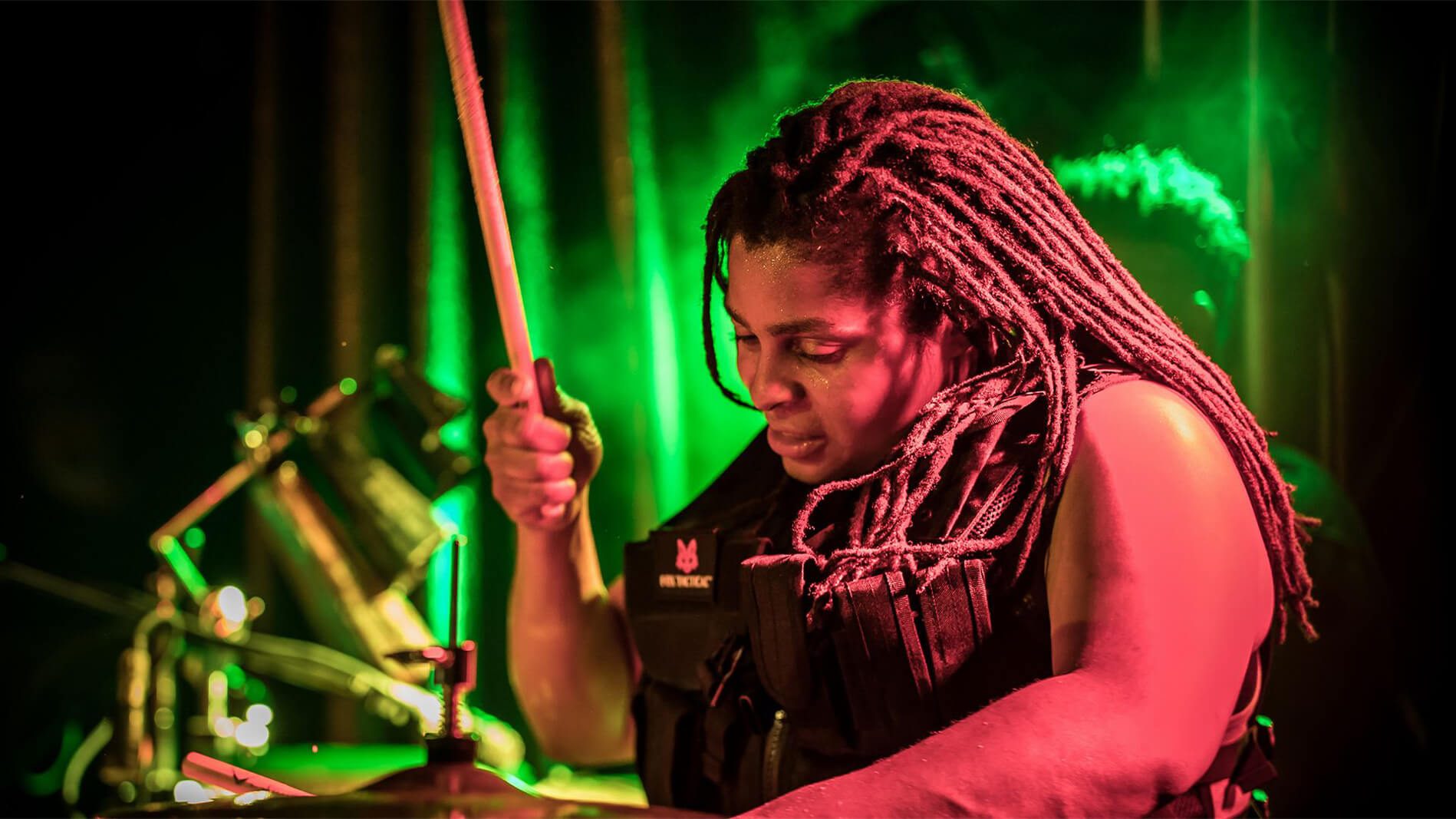
“As a drummer, I carry very heavy gear, and people are always like, Why don’t you get a drum tech? And I’m like, I really do this to stay grounded. When you have to set up your own stuff, and it’s just not there waiting for you, there’s something to doing that work, like doing the mundane, and actually, there’s something to that just in life in general. Like doing work that people think is for others to do. It’s like, no, you do that yourself. That makes you a person.”
Follow Nikki Glaspie on Instagram here.
PHOTOS: NIKKI GLASPIE