
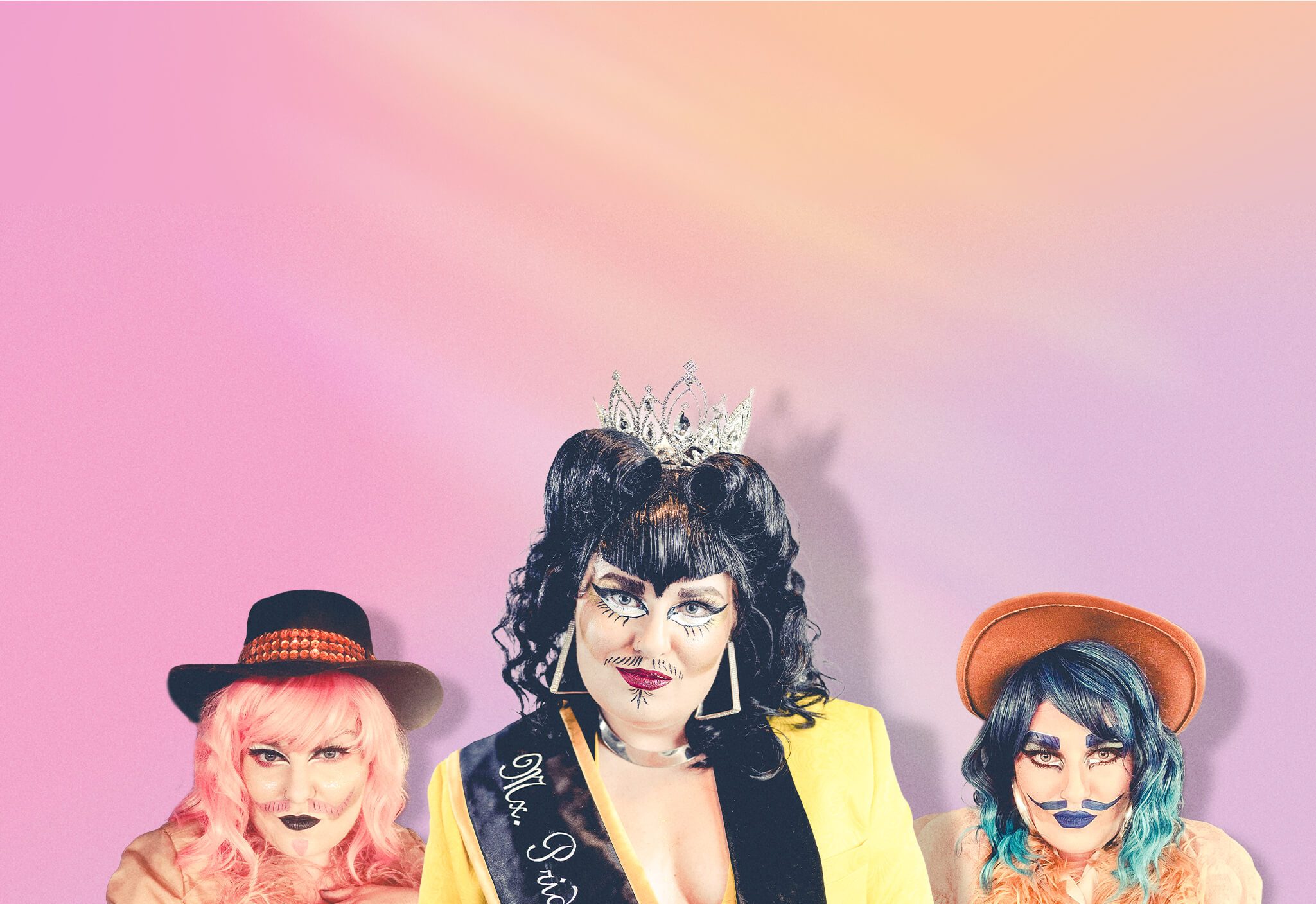
1: FENDER BENDER THE NIGHT SHE WON HER FIRST COMPETITION, JANUARY 2023 2: PHOTO: ZACHARY STEELE 3: FENDER BENDER WITH BLUE HAIR
At just 31 years of age, Gabe Montesanti has two memoirs behind her. Brace for Impact, in which she chronicles her journey as a queer youth in roller derby, and Drag Thing: A Memoir of Mania and Mirrors. This book, out now, is timed perfectly for Lesbian Visibility Week and raises many questions vital to that celebration.
Montesanti notes that both roller derby and kinging, at which queer women excel, have a lot in common. “If I had to say one particular thing that links them, it would be persona. That originated for me with the Catholic Church in the Sacrament of Confirmation, when I named myself Anne with an E after Anne of Green Gables, not after Mary’s mother. I was always influenced by sort of rebellious girls in literature.”
This was in the 8th grade, long after Montesanti confirmed her identity as a writer—that epiphany occurred in the 3rd grade when she wrote a letter to celebrated children’s book author Kate DiCamillo, who replied!
Montesanti’s next act of self-confirmation was when she named herself Joan of Spark (her roller derby persona), and after that, Fender Bender (her drag king persona). The meaning behind that name is explored in Drag Thing, along with the St. Louis-based writer’s working-class background and expansive, experimental approach to gender.
“I sort of morphed into ‘drag thing,’ which was unclassifiable,” she says. Not only is there a power to self-naming, but a “power reaped through parody,” which is one of the time-honored tools of drag. Like many Gen Ys, Montesanti came to drag through the phenomenon of RuPaul’s Drag Race, but she is hungry for the history of earlier lesbian progenitors of drag kinging and queening (Diane Torr, Mo Fischer, Sexy Galexy), as well as its current advocates such as the delightful Rose Butch, and Chappell Roan.
Along with inspiration from her beloved dogs, Lady and Rocko, and support from her then-girlfriend, Kelly, Montesanti received career guidance from drag performers assigned female at birth who performed mostly masculine-oriented drag. But increasingly, she was drawn to high glam, undefinable, binary-blurring expressions: a public, experimental self-exploration of gender.
“I was seeing, especially for myself, that there was a clear distinction between people who were sort of striving for a more mainstream RuPaul look, and then people who, like me, maybe didn’t have that same aspiration or, even had a series of looks that were parodying RuPaul’s Drag Race and making costumes out of materials like sponges, Dollar Tree paper bags, or sunglass lenses. Cheaper materials, more fascinating than beautiful.”
“I identify as a lot of different things,” Montesanti says, “and I know that for a lot of people putting an identity and a label on is really important, especially for their safety. But for me, I use a lot of different terms. I use gender queer, I use gender fluid. I use lesbian. I use woman. I use she/they pronouns. For me, it’s not as important what people use to define me. I feel very fluid in how I identify, and I think a big part of that was drag.”
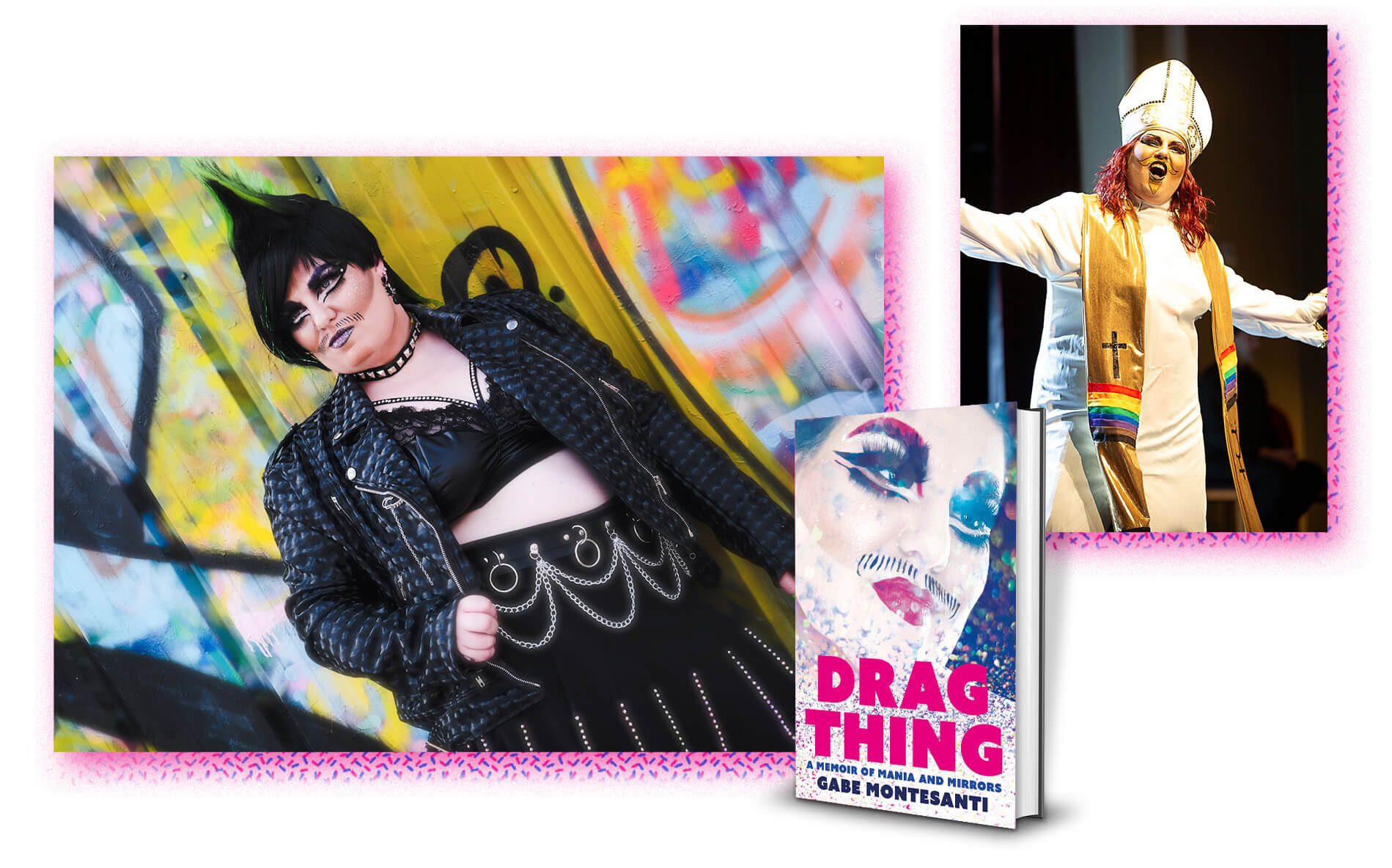
PHOTO CREDITS: EL FITZ; SHELBY BASELER PHOTOGRAPHY
Drag Thing is also a memoir of Montesanti negotiating with her bipolar diagnosis, especially the meaning of mania.
“It’s part of my identity. I think my bipolar disorder and my creativity are inextricably linked, and I learned that, as I was writing this book, it has effects on the way that my brain processes information, the way that I feel inspiration, the way that I sleep, the way that I take in the world. When you oscillate between two poles, you really have to respect that there are going to be periods where you have to rest and periods that are lush with creativity. It’s just a matter of acceptance of both of those time periods of your life.”
To be working all this out publicly and visibly is commendable and essential to our community. The personal is indeed political, and our current political climate, which seeks to ban drag and trans identity, comes from “deep-seated fear,” according to Montesanti. Fear and lack of understanding, a misguided belief that drag as a form of artistic expression, and trans as a form of identity, have something to do with a profane sexuality. People who want to outlaw drag are afraid of breaking or blurring the binary and losing the power that accrues from such clear divisions.
But Montesanti knows firsthand from her own performance art that there is power in being a drag thing: “it’s literally the mirror, and I think it scares people, you know? It scares them when they see a figure in makeup, and they don’t know exactly how to label it.”
Excerpt: Chapter 12: Drag Thing
Back home, I nurse my sore feet and stay up well into the night researching the PrideSTL Royalty Pageant. The next day, I sit in my backyard while Lady and Rocko fight over a stick. Mars is on speakerphone while he finishes his shift at the post office. It’s already hot for spring, and I perch on one plastic chair while resting my hairy legs on another. The blue nail polish on my toes is chipping.
“What are you wearing?” I ask Mars.
“What do you think this is, phone boning?” he asks. “I’m wearing my mail carrier uniform.”
“Isn’t it kind of balmy for that?” I ask. I’m beating around the bush; what I really want to tell Mars is that I’ve already filled out my application for the pageant. Even after all my research, though, I still don’t fully understand what it entails. It just means a lot to me that someone in the drag community believes I’m capable of competing in a pageant. I’ve always craved the approval of coaches, captains, and professors. When someone in a position of power gives me guidance and encouragement, and it happens to align with a future I can envision for myself, I feel unconquerable—similar to how I feel when manic.
My parents’ vision for me was often the opposite of what I wanted. My mother said she had a reconceived idea of who I would become and what I would do with my life, and that was partially why my coming out at eighteen was so devastating to her. She wasn’t keen on my moving back to New York City after I graduated; instead she encouraged me to pursue an entry-level library job in Flint, a town close to where I grew up, where, at the time, the water was contaminated with lead. Assuming that my declaration of queerness meant I would not or could not have children, which had always been part of her fantasy for me, she said, “Now, you’ll never get to experience the greatest love on Earth: the love between a parent and their child.”
I still think about her statement and the fact that she believed it to be true. I’ve always wrestled with the idea of love and how it was expressed—between parents and children, between romantic partners, between platonic friends. At times I worry about enmeshment with Kelly—always opting for we over I—though now, I can feel the we gradually unravelling.
Through my grainy phone speaker, I hear Mars saying goodbye to his friends at the post office and starting his car.
“So, I’m pretty sure I’m going to turn in my pageant application today,” I say. “I had this idea for the first category, Presentation of Pride. Since I really like making things out of weird materials and it’s kind of my signature now, I was thinking: What if I make something out of trash?”
The line is silent for a few beats, then Mars screams, “Girl! What does trash have to do with pride? If the judges see you come out looking like a glue-gunned dumpster fire, you might actually get negative scores. Remember what I said to you? Pageants are pristine and particular environments. They’re like beauty pageants on fucking steroids.”
I laugh, but Mars doesn’t.
“The thing with that category is that it has to be thoughtful,” he continues. “You can’t just drape a rainbow flag over yourself and call it pride.”
I hear a strange, mechanical sound and ask Mars where he is.
“ATM. I have to deposit all these one-dollar bills from the show last night.”
“God, you’re such a ho,” I say.
“I mean, duh. Can I ask something that might help with this category? How do you identify?”
It is my turn to pause. “Can I do a pageant if I don’t know?”
“Not having a clear idea of how you identify doesn’t make you any less queer than anyone else,” he says.
It seems like the people around me, especially those in their twenties like Mars and me, draw comfort from their labels, whether it is a sexual identity, a diagnosis, an achievement, or a relationship with another person or animal, so hearing Mars say this is a relief. I doubt I’ll ever have the language for my identity, or multitude of identities, or that they’ll ever stay static long enough to pinpoint. I know that for many people, having language for their identity is vital to their survival, but I just want to exist in the world without putting so much emphasis on what I call myself. I’m perfectly content being a question mark to people who don’t understand my hairy arms and legs, my chain necklaces, my so-called feminine clothes and dyke boots. I’m fine having testosterone levels higher than most people assigned female at birth and not taking hormone blockers to “fix” that, especially if the only benefit is cosmetic. None of these external or internal markers contribute to my concept of myself. I’ve used so many terms for myself throughout the years, particularly as I weigh how safe I feel in various places: gay, lesbian, dyke, homo, faggot, woman, non-binary, genderqueer, genderfluid, and finally, drag thing, the definition that for now feels the most right.
Still on the phone with me, Mars gets home to find a package waiting for him: It’s the outfit he ordered for his step-down look for the pride pageant. It’s tradition for every member of the previous year’s royalty court to perform a final number at the pageant, representing their title one last time before passing on the crown to the new category winner.
“Bitch, you’re not going to believe this,” Mars says. I can hear him grunting as he shimmies into his look, then he texts me pictures of himself standing in front of a long mirror in a ruffled collar shirt with black lace underneath. He looks like one of the sexy vampires on the front cover of the weathered, dog-eared paperbacks I used to shelve at the public library as a teenager, and I imagine the way he typically dances, bouncy and exuberant, with sharp, decisive movements that get the crowd clapping and on their feet.
“Sickening,” I say.
* * *
In the following days, I think more about Mars’s reassurance that I can identify any way I want and still compete in a pageant. I’m so relieved there’s a Mx. category, since it won’t feel natural for me to enter any category that positions me on one side of the binary. I know that by entering the Royalty Pageant, I can continue creatively on the same trajectory I’ve taken since the night I performed “Butterfly.” I consider how transitioning from drag king to drag thing has opened a new way of looking at what Rocky calls my long-term art project. I’ve traded in my coveralls for bare binding and Dollar Tree bag skirts, my workboots for six-inch heels and glittery moustaches. I’ve begun making musical compilations. Thinking about this newfound creative freedom also leads me to start wondering about the history of modern-day drag things. Before I began performing drag over a year ago, I had researched the early male impersonators, drag kings, and nonbinary entertainers who fit within the scope of what some would call drag things. I want to know how the term crept into modern drag slang and who might be behind it.
When I do a cursory online search, the top hit yields a drag name that gives me so much pleasure I let out a bark of laughter: Rose Butch. They are petite, with a face that is often painted white like a mime’s, and they have hundreds of looks involving such incredible detailing I have to hold my phone inches from my face and zoom in to fully appreciate them. In one high-glamour shot, they pose with a hand propping up their cheek. Their face is painted lavender, with eyelashes as long as my pinky finger. Wearing a white beret and a purple fur scarf, each of their decisions serves the outfit: their large gold septum ring, the tiny eyeliner hearts on their cheek and forehead, the rhinestones on their matching gloves. This isn’t their only picture that makes me feel a sense of belonging. Everyone shows me a new way to be a drag thing. There are photos of Rose in sunglasses covered with googly eyes, in Dali-esque moustaches against white face paint and red lips. Browsing all their looks and experimentations is like flipping through the pages of the queer fashion magazine I wish I could have handed myself as a teenager.
I message them directly, a move that feels easy when I’m elevated. I tell them I’m a drag performer in St. Louis, that I love their drag, and I would love the chance to talk more. They reply that they’re interested.
Before our phone call, I watch and rewatch a CBC interview with Rose (a.k.a. Rae Takei), from which I learn that they have been performing since 2014—more than eight years. They went to theatre school to become an actor but encountered problems related to gender and casting, as they were being assigned very gendered roles. They were twenty-one at the time and just starting to realize they were non-binary. Failing all their acting classes but excelling in movement and voice classes, they decided to go into production, “So I could make the theatre I want to see.”
I’m deeply fascinated to learn how the term drag thing applies to Rose’s life.
“For me, drag is just gender performance, and I’m performing
non-binary gender, whatever that is. I’m not a drag king or a drag queen—I’m a drag thing. Once I took away those expectations of I need to perform this way, it sort of opened things up for me.”
As they show the camera their two closets stuffed full of drag garments, they explain, “Some folks have a hard time separating themselves as a person and themselves as a drag performer. Just Drag Thing for my personal sanity, I wanted to have some separation between that.” They say that Rae is not as adventurous as Rose. “Rose is a lot more confident than Rae is. Rae is learning from Rose in terms of confidence.”
I feel a deep connection with Rose, thinking of Fender’s unshakable confidence, especially with the recent successes at Rising Stars, so vastly different from the way I used to feel threatened by external factors, so riddled with anxiety and panic I couldn’t do my job. But how much of Fender’s confidence is just a mania smokescreen? Is there any separation between Fender and me? Sometimes it doesn’t feel like it, especially when my mood shoots up. Fender sometimes acts like the antagonizing element in an explosive science experiment. Until now, it hasn’t occurred to me to wonder whether I’m learning anything from Fender—the assertiveness I lacked while teaching in Texas, a certain androgynous sensuality, or even a new skill like dancing or stage presence. Fender is the double-sided queen or king on a playing card: my perpetual mirror image. I remember the time I had to disclose to a new therapist that I was bipolar. “You are not bipolar,” she said. “You suffer from bipolar. The disorder is not you.”
I don’t know what I think about that. I understand her logic and why many people might prefer to phrase it that way, but I want to be able to make that decision for myself. Maybe, like my kaleidoscope of identities that shifts at every turn, my feelings about how I talk about my relationship to my disease will change. But for now, this is the way I prefer to do things: the label “bipolar,” like drag thing, fits the best, and when it’s necessary, I will use it.
As soon as I sit down on my dad’s old La-Z-Boy in the attic—my singular family heirloom—and begin speaking to Rose Butch over the phone, I can tell they’re an immensely kind person. They describe their introduction to drag through Man Up, Vancouver’s longest-running drag show. Paige Frewer, the creator, describes one of the goals of the show as “making room for the weird, the angry, the horny, the heartfelt.” The stories they want to uplift at Man Up, Paige says, “aren’t for rainbow-branded billboards.”
“It didn’t occur to me at first that my drag could be non-binary,” Rose tells me. “Back then, Man Up was primarily a drag king show, but now there are lots of different gender expressions. It was a different time. This was before RuPaul’s Drag Race, and before social media was what it is now. But I realized I didn’t really want to be in the binary of drag kings or drag queens. Drag is a container that can hold so many different things. Why follow rigid standards?”
I swing my legs to one side of the armchair and nod enthusiastically, almost forgetting they can’t see me. Rocko and Lady have clambered up the stairs to join me, and they start loudly wrestling. I herd them downstairs and slam the door to the attic shut while asking my next question.
“How do you feel about people using the term drag thing? I’ve struggled for a long time with what to call myself, but in drag, the term thing fits me so well. I just wonder if you’re okay when other people claim it too.”
I almost hear Rose smile as they speak. “Oh, I’m totally fine with people using that term. With drag and gender and any kind of expression, I think there is fluidity to it. Think about Maddy Morphosis, a straight cis queen. Who knows what’s going on inside them and where their drag might take them? Drag can be a way to discover things about yourself.”
We speak about how RuPaul’s Drag Race has immensely and irreversibly changed the course of drag, wrenching it from the underground into the mainstream. Rose tells me they didn’t watch Drag Race when they were starting out. People often compare them to Gotmik, the first trans man to compete on the show, who has a white-face aesthetic similar to Rose’s. (Rose calls their own makeup style “Rococo clown angel baby.”) They also say that Drag Race isn’t as popular in Canada as it is in the States, which leads me to ask more questions about drag in Vancouver.
“There’s nothing really like it,” Rose tells me. “I’ve been to several Canadian cities. In Vancouver there’s the West End, which is the gay village and a little more conventional with its drag queens, but the East Side? That’s the side I came up in—the DIY side, the alternative side, and the side where the lines blur. I felt supported by the kings, but sometimes the crowds would expect one thing from me and get something else entirely. Sometimes they would mess up my pronouns or just get confused. But we connected over the Millennial throwback songs I chose, and over time, they caught up. They were interested in what I was doing and in the possibility of different kinds of drag.”
I’m so absorbed in imagining the drag landscape Rose is describing that I forget to respond when they stop talking. Some of the crowd reactions to my performances have been exactly what I was hoping for—I will never forget the night I released hundreds of paper butterflies from my bra, and I recently won another Rising Stars with my performance of “No Scrubs” in the sponge suit—but many more of my performances received only blank stares. What would my critiques have been like if I performed the number in the hospital gown and grippy socks in Vancouver’s East Side? “That shit was like performance art,” one judge said.
As our conversation reaches its conclusion, I ask Rose why they need drag in their life.
“Well, first, it’s my community. But also, there were so many times when I would just feel so dysphoric and unhappy, and I had no idea what I looked like. I would pass a mirror and be like, What? But with drag, because it is so intentional and because I have to sit for hours deciding how I want my face to look, drag becomes this portal. Makeup and drag become very transformational. It’s a way to see yourself in a different light—for me, to take Rose Butch as far as I want. It really shows Rae the possibilities of who I am.”
I thank Rose and hang up. I briefly worry that I’ve made a huge mistake in deciding to do a pageant. What Mars said earlier, that “drag pageants are like beauty pageants on fucking steroids,” keeps coming back to me. Can I somehow merge the kind of aesthetic that I so identify with in Rose’s art with the environment that Mars is preparing me for? I’m not sure, but I am curious to try.
I immediately start researching drag in other cities; I feel a pull to experience drag outside of St. Louis. In many ways, drag in St. Louis is wonderful, primarily because of all the encouraging people. But after hearing Rose describe the scene in Vancouver, I’m itching to travel. Before I started applying the term drag thing to myself, I went to Houston to visit one of the remaining lesbian bars in the country with my drag king class teacher, Ian Syder-Blake. I wonder how that experience of drag—structured classes that lead students, particularly assigned-female-at-birth drag kings, to the stage—will be different now that I enjoy breaking the rules a bit more and blurring the lines.
I first find out when Man Up occurs during the year, to see if a trip to Vancouver is possible. My interest has been piqued by Rose’s description of the show and the East Side that had raised them with the alternative DIY mentality that I’ve had all along. But since I have no one to stay with in Canada, and any extra money I have will be going toward the pageant, I ultimately decide to stay closer to St. Louis.
I start researching drag shows in Denver, where I can spend a few days with my cousin and my lesbian aunts, and I immediately find one called Stage Fluid that seems to have the same spirit as Vancouver’s East Side drag scene. “More than a drag show!” the flyer promises. In pictures of previous casts, I see plenty of performers wearing vivid costumes that look hand sewn and self-designed. Unlike most drag show posters I’m used to, the Stage Fluid flyer includes information for contacting the show director if we’re interested in joining. Within minutes, I have a booking, a plane ticket, and the promise of an entirely new landscape—both geographical and drag—in the heat of the coming summer.
* * *
Reprinted with permission from Drag Thing: A Memoir of Mania and Mirrors by Gabe Montesanti (Arsenal Pulp Press, 2026). Buy the book here.