
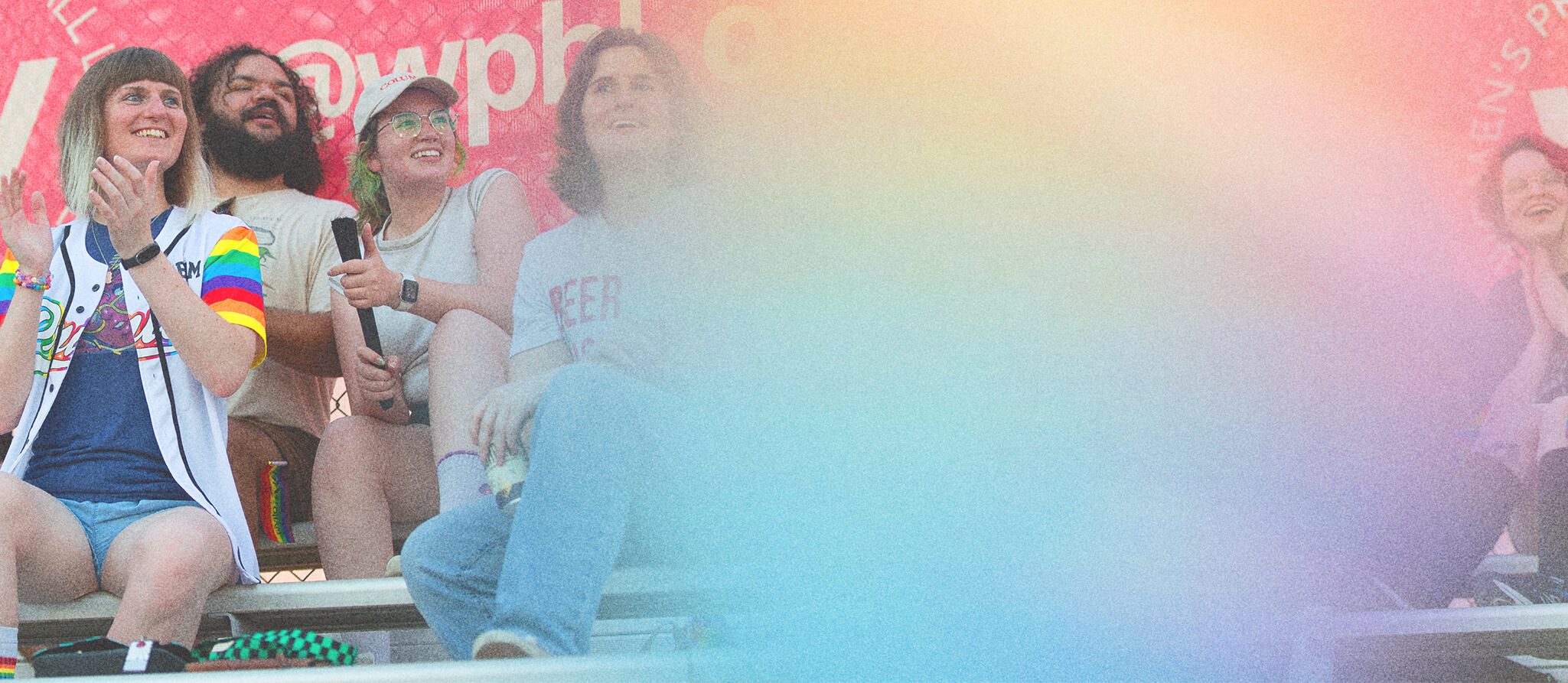
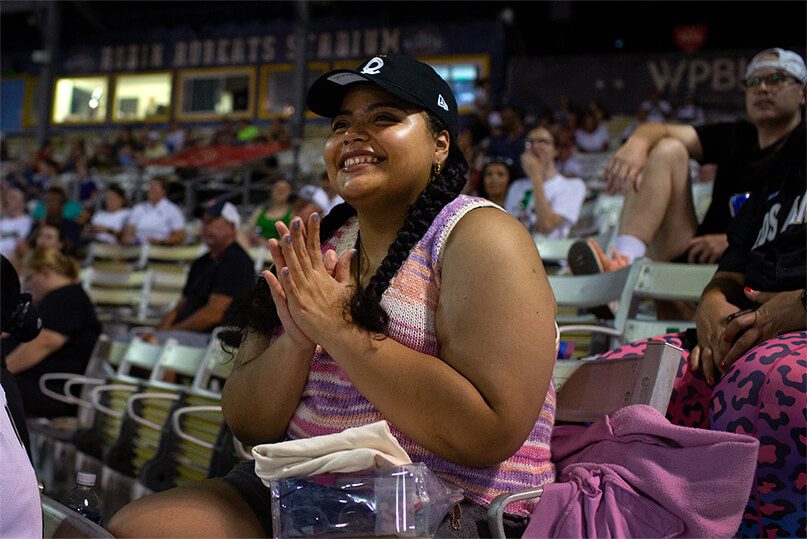
ANGIE ALVARADO TRAVELED TO SPRINGFIELD FROM FLORIDA TO WATCH THE NEW YORK HEIGHTS V. LOS ANGELES QUEENS GAME ON PRIDE NIGHT AT ROBIN ROBERTS STADIUM, SEPTEMBER 3, 2026.
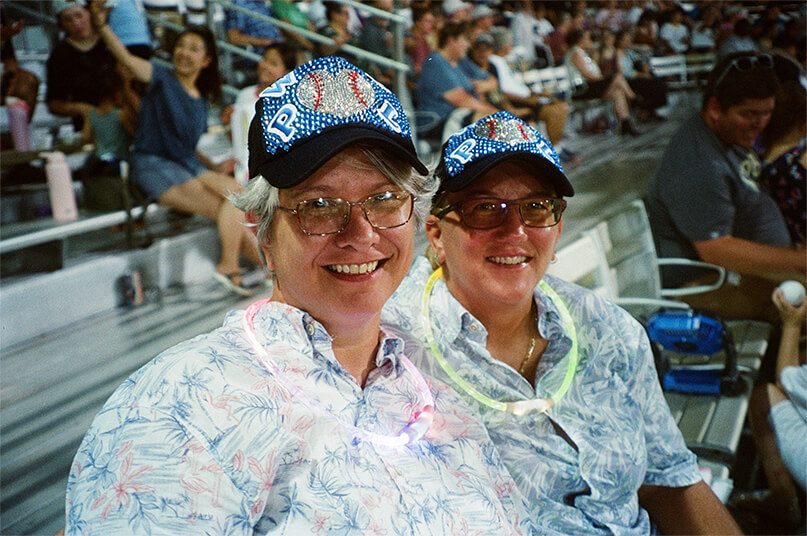
SHANNON HENSLEY AND SHERI PIERCE TRAVELED FROM ORLANDO, FLORIDA, TO SEE THE NEW WPBL PLAY IN SPRINGFIELD, IL.
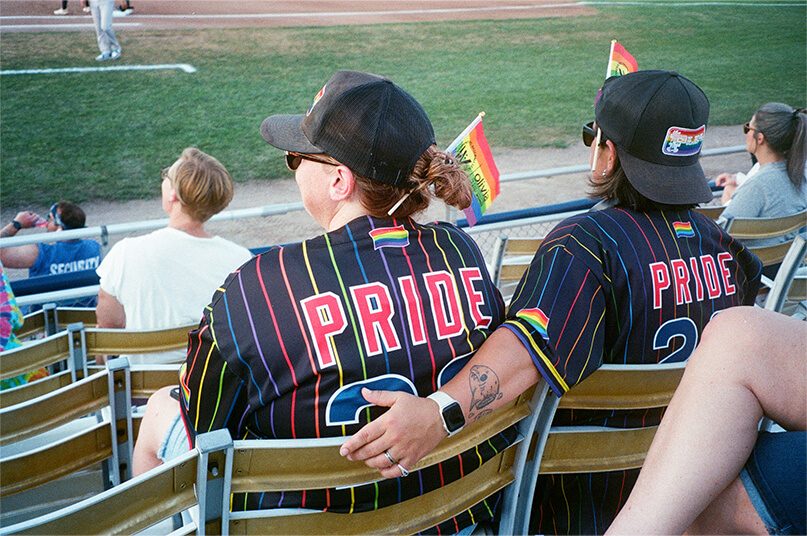
FANS WATCH THE NEW YORK HEIGHTS V. LOS ANGELES QUEENS ON PRIDE NIGHT AT ROBIN ROBERTS STADIUM IN SPRINGFIELD, IL.
The Women’s Pro Baseball League (WPBL) played its first historic season in Springfield, Illinois this summer. The league’s four inaugural teams, the San Francisco Firebells, Boston Hunters, Los Angeles Queens, and New York Heights, competed against each other, with the Queens winning the championship. Fans from the Midwest and across the country descended onto Robin Roberts Stadium in Springfield to see the games and witness this historic moment in women’s sports history.
And where there are women’s sports, there will be the queer community. Many LGBTQ+ fans root for women’s sports teams because they see something about themselves reflected in these athletes. Inside the stadium, there’s a space where women are celebrated for being powerful. Cheering for these athletes can sometimes feel like rooting for a world where no one feels discrimination or limitations based on their gender or sexuality. I certainly felt this energy at the ballpark in Springfield this summer.
The WPBL is the first women’s baseball league in the U.S. to play in over 70 years. The first iteration, the All-American Girls Professional Baseball League (AAGPBL), was founded in 1943 by Philip K. Wrigley, then-owner of the Chicago Cubs, along with a group of trustees and supporters. Wrigley worried that due to male baseball players being drafted into WWII, major league parks would face financial challenges. He looked to women athletes for a solution. The 1992 blockbuster movie A League of Their Own was based on the AAGPBL’s history, and enshrined this story in American culture.
The pioneering AAGPBL spanned 10 teams at its height
and played until 1954. Yet in keeping with the political
tides of the ‘40s and ‘50s, the AAGPBL was not affirming
to lesbian players. As Lois Browne writes in her book
chronicling the history of AAGPBL, Girls of Summer: In
Their Own League,
“The All-American had lesbianism on its mind, but they
didn’t choose to meet the issue head-on with plain
speaking…The fear of lesbianism prompted one
All-American manager to release two players because
he was certain they were lesbians and thought they
might ‘contaminate’ the rest of the team.”
This summer, I spoke to four out players in the WPBL
about what it means for them to be playing in the league. I
captured their portraits, along with photos of the league’s
Pride during the first season. These conversations have been edited and condensed.
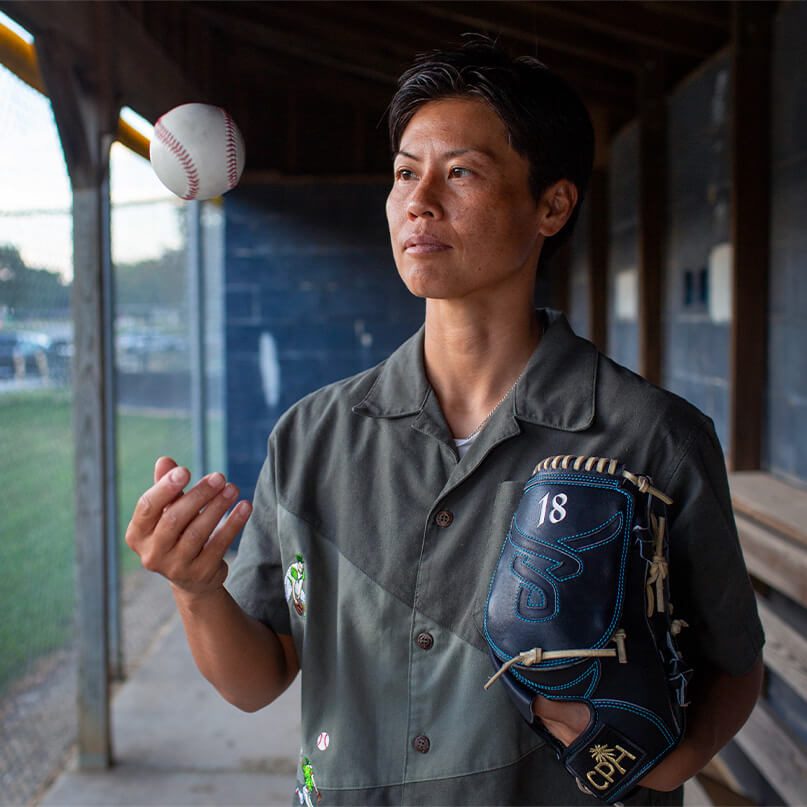
AYAMI SATO, A RECORD-BREAKING PITCHER BORN IN KAGOSHIMA, JAPAN, WAS THE SECOND PLAYER DRAFTED IN THE WPBL. SATO PITCHED FOR THE LOS ANGELES QUEENS IN THE FIRST SEASON IN SPRINGFIELD, IL.
Ayami Sato
Hometown: Kagoshima, Japan
Team: Los Angeles Queens
Translated by Mayo Hirano
On gender discrimination in baseball
“For many people around the world, there has been the
idea that baseball is a men’s sport. So knowing that we’ve
all come from that kind of environment, and that we’ve
now been able to play together, makes this especially
meaningful to me. So in this league, no matter what
gender you are, what age you are, what kind of person
you are, you just enjoy playing baseball. It means a lot. I
feel this league has the power to inspire people, and that’s
why being able to play here is really special to me.”
What has the WPBL’s LGBTQ+ fanbase meant to you?
“I’ve noticed [LGBTQ+ fans] a lot, actually. It means a
lot to me, and it makes me really happy. At the last LA
Queens game, which was Pride Night, I knew that was
what the night was about, and seeing so many people
come to the stadium wearing rainbow colors and
holding rainbow flags showing their support made me
really happy.”
“Being able to reach those players through baseball and
hopefully give them strength or inspiration is one of the
things that makes me happiest about playing this game.”
What has your experience been like playing in the WPBL’s
first season?
“One thing that makes playing here so meaningful to me
is that I’m now playing in a place I never could have
imagined for myself, not even in my dreams before.”
“I also feel like this is a place where I can truly be myself.
When I was young and playing baseball, people would say
things like, ‘You’re a girl, so why don’t you play softball
instead? Baseball is for men’s sports. It’s not for girls.’ So
there were times when my gender created barriers that
made it difficult for me to simply play the sports I loved.”
“And beyond baseball, being in an environment where I
don’t have to think so much about my gender or my
sexuality, and where I can simply be myself means so
much to me. So both on and off the field, I really feel like I
found a place where I belong, a place where I can truly be
myself here.”
Is there anything I haven’t asked that you want to say?
“I want to keep telling people that if you believe it, you
can do it.”
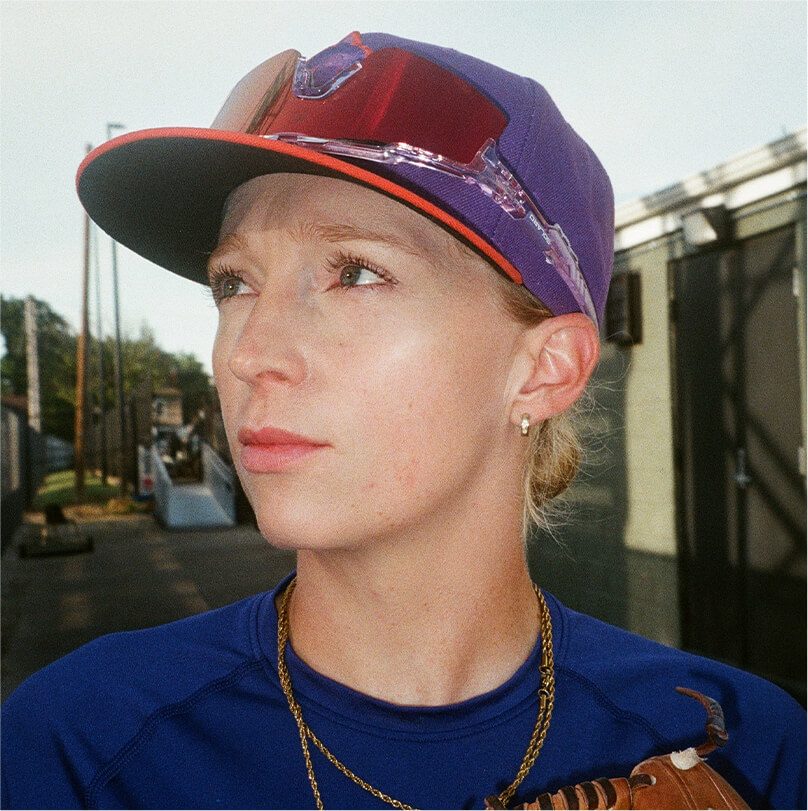
AMANDA GIANELLONI, FROM NEW ORLEANS, LOUISIANA, WAS THE EIGHTH PLAYER DRAFTED IN THE WPBL AND STARTED AT SECOND BASE FOR THE SAN FRANCISCO FIREBELLS IN THE INAUGURAL SEASON.
Amanda Gianelloni
Hometown: Napoleonville, Louisiana
Team: San Francisco Firebells
What does playing in the first season of the Women’s
Pro Baseball League mean to you?
“It’s a dream come true. This has been my goal—to play
professionally—my entire life. I’ve played at every other
level, but there weren’t any paths to play professional
women’s baseball until now. I certainly didn’t think it
would be in my professional career. I thought I was going
to be long-retired by the time that a professional women’s
baseball league would be a thing. But to have it now, while
I’m still playing, it’s almost like the cherry on top of my
athletic career. I think me being here is just a testament to
perseverance, overcoming adversity, and just never giving
up on your dream.”
It’s been so sweet to see your wife, Victoria, cheering you
on in the stands the whole season. Have you felt like the
league has been welcoming and affirming to you as a
family being here, especially since Victoria is pregnant?
“It’s been normalized here. There hasn’t been one awkward or judgmental interaction since we’ve been here with a fan, with anyone at the front office, with a sponsor, with a staff member. It’s been nothing but supportive, and it’s been so supportive that some of the staff members at the stadium have even bought our baby gifts.”
What has it been like playing in this pivotal moment of
your athletic career, while you’re also about to experience
a new, exciting family transition?
“I’m honestly staying present in the league right now. My
biggest focus is just supporting my wife. I keep telling
her, ‘Look, we’re gonna worry about the baby shower and
the nursery and all the other things when we get home.’
I’ve just been trying to be present. This has been a dream
of mine since I was young. So obviously, trying to stay
as present as possible because I know when we get
home, it’s all about prepping for the baby. So in terms of
being here, my biggest focus is just making sure that I’m
being supportive of her and making sure that she’s
comfortable. She has what she needs during this time
while we’re here.”
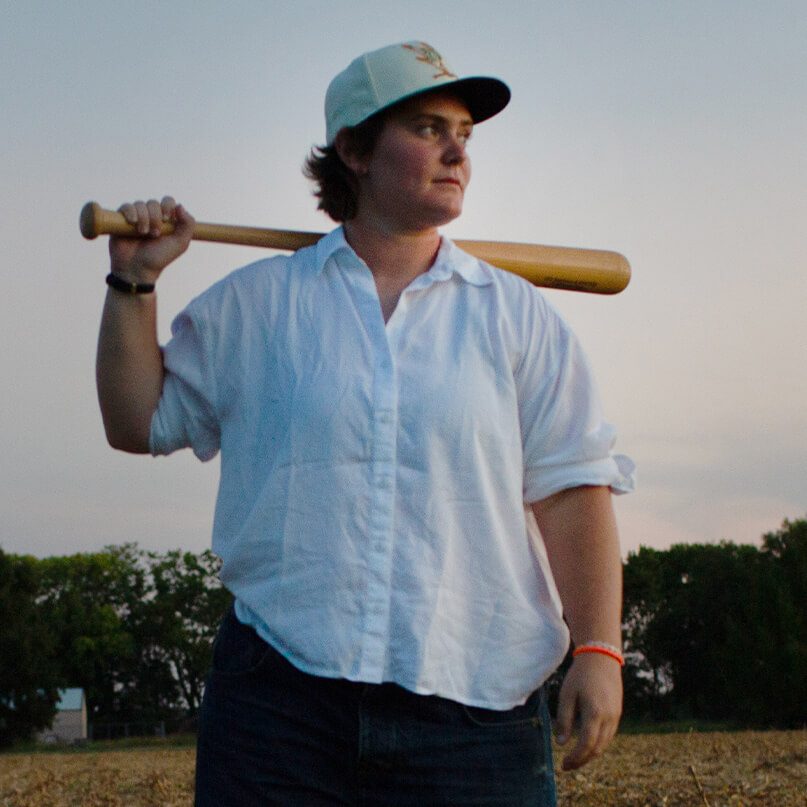
PALOMA BENACH, WHO GREW UP IN WASHINGTON, D.C., WAS DRAFTED TO THE BOSTON HUNTERS AND PLAYED AS A PITCHER IN THE WPBL’S INAUGURAL SEASON IN SPRINGFIELD, IL.
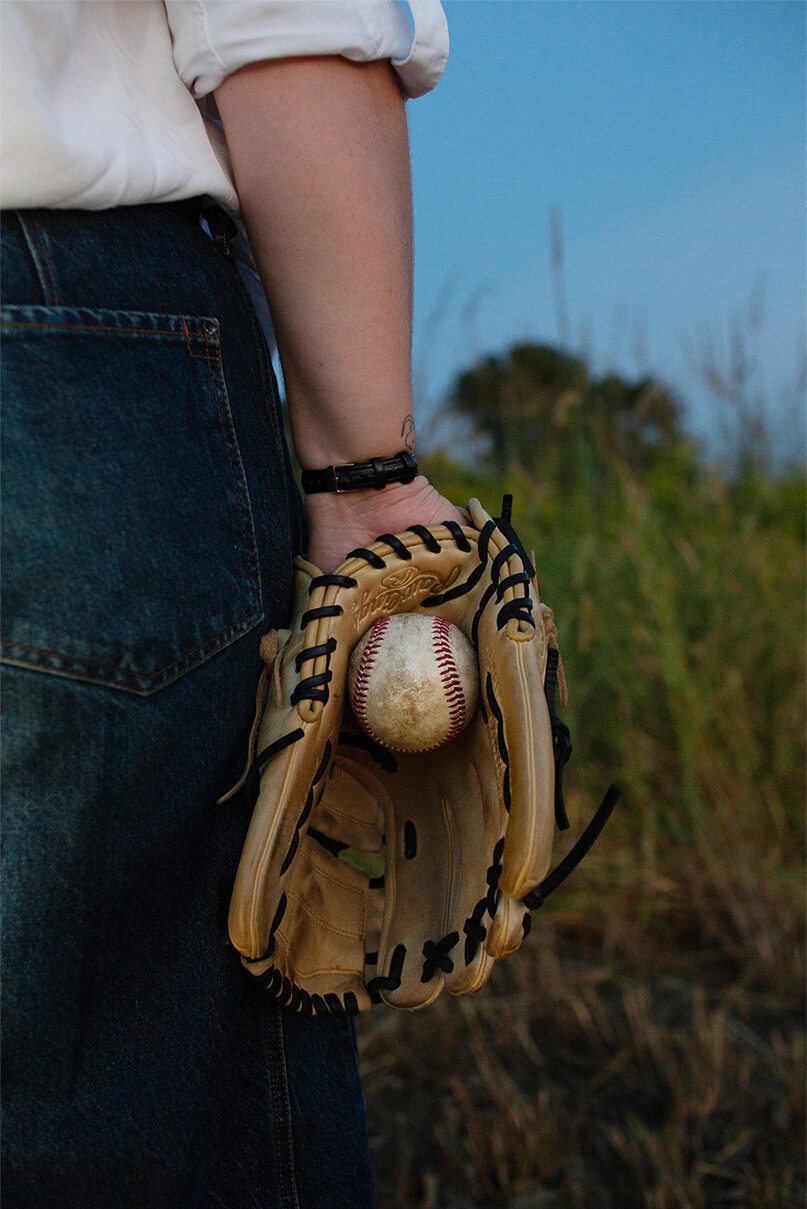
PALOMA BENACH, A PITCHER FOR THE BOSTON HUNTERS, HOLDS A
BALL IN HER GLOVE IN SPRINGFIELD, IL.
Paloma Benach
Hometown: Washington, D.C.
Team: Boston Hunters
What does being a queer baseball player mean to you?
“Growing up, I feel like I was always known as the
‘baseball girl,’ which parts of me really liked, and then
parts of me really didn’t like because it felt like it was my
only identifying factor for a lot of my life. And I feel
somewhat thankful that I never really felt that way in
terms of my sexuality. I never felt as though it was my
sole identifying factor. There was a lot more to me than
just being, you know, the gay girl. Most of my family is
queer, so it never felt like it was something I should be
ashamed of, or I should hide, in any which way. So I’m
super thankful for that.”
Can you talk about why you’re open with your sexuality?
“I think I figured out that I liked girls when I was in seventh
grade. I was a really angry kid at the time, and I couldn’t
really figure out why. And then I watched a TV show, and
someone was coming out to their family members. She
just talked about feeling like this rage inside her, and she
didn’t want to feel like she’s fighting all the time, just like
fighting herself [and] against who she is, and it just kind of
clicked with me. As soon as I figured it out, I told my
parents because I didn’t want to feel like I was fighting this
internal battle with myself when I never really felt a need
or a reason to not fully be myself.”
When you were trying out for the WPBL and becoming a
professional baseball player in recent years, did you ever
question whether to stay public about your identity?
“I think that’s one of the things that the league has
actually done really well—recognizing not just the
percentage of queer players they have in the league, but
the high percentage of fans that identify as LGBTQ+, and I
think the best thing they could do is like really lean into
that and really embrace that because it just makes the
love of the game grow for everyone. Women’s baseball is
always about being accepting and feeling like you’re in a
safe space and community, and so a lot of those same,
you know, values and ideals are similar in the queer
community.”
In the All-American Girls Professional Baseball League in
the 40s and 50s, players could face consequences or be
let go if they were suspected of being gay. Has that been
on your mind at all, just understanding the history and the
progress that’s been made today?
“I grew up on men’s teams, and I feel lucky that I never
really had to hide my sexuality. It actually probably helped
me in a lot of cases being around a bunch of guys, but
this is just even better because it’s like hanging out with a
bunch of my teammates—a bunch of them are queer
women—and that’s an even safer space.”
What is it like playing in a league that has a big number of
queer women?
“It feels incredible. Like this is probably the most fun I’ve
ever had playing baseball. And it’s been great because we
can all share stories about our experiences in baseball,
school, and life. A bunch of us are in, you know, very
different places in our lives, but there are consistencies, like
sexuality, like playing baseball growing up, and to be able
to have people that really understand that and really
identify closely with that is just so comforting.”
Have you felt support from LGBTQ+ fans and that
community, and how has that been?
“It’s been amazing. I think gay fans are the best fans.
They’re just so passionate, and they feel like they’re in it
with us, and that’s really special to be a part of. And I’ve
been so happy to see the amount of queer representation
in fans in the stands when we’re playing. There’s so much
joy being expressed in the stadium, and it feels like such a
magical place for so many people. And the players
absolutely feel the same way.”
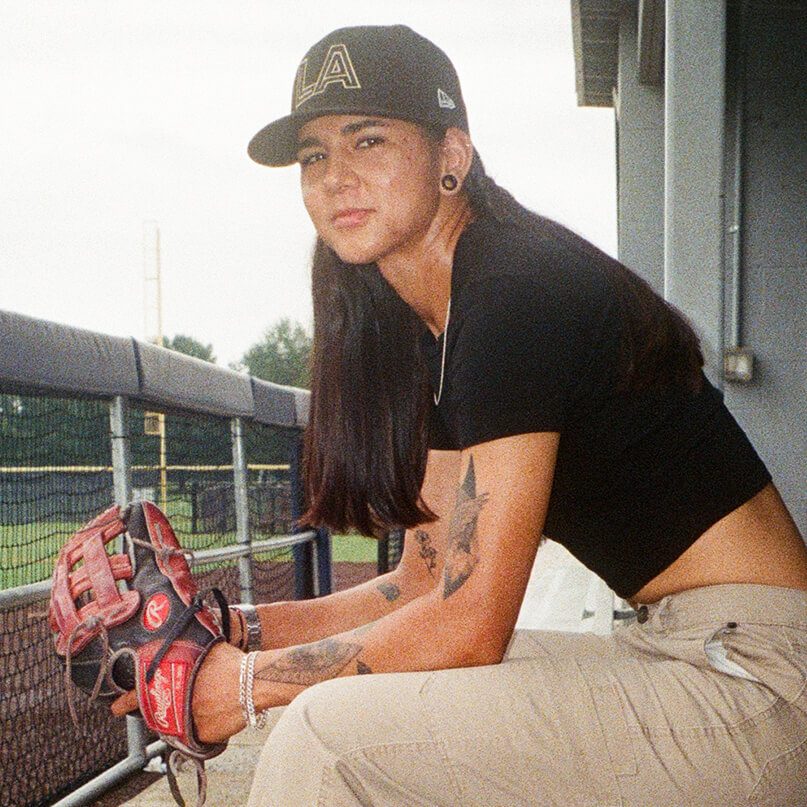
DIANA IBARRA, AN OUTFIELDER FOR THE LOS ANGELES
QUEENS, IS A TRAILBLAZING BASEBALL PLAYER FROM PEGUEROS,
JALISCO. IBARRA WAS DRAFTED IN THE THIRD ROUND FOR THE
INAUGURAL WPBL SEASON.
Diana Ibarra
Hometown: Tepatitlán, Mexico
Team: Los Angeles Queens
Translated by Anna Casey
What has the opportunity to play in the WPBL meant
to you?
“I think it’s been a great opportunity. I’ve worked many
years to be part of something this big, and now there’s
finally a professional opportunity for women. It was
something difficult we were always trying to reach. Now that
it’s here and we’re making it happen, there are a lot of
emotions at once. Every time we go to practice or step
out for a game, I feel nerves and excitement, thinking,
‘Okay, I really am living the dream I worked so hard for.’”
“Ever since I was little, I played with boys. When I grew up,
the girls’ league ended, and I had to switch to the men’s.
To this day, I still play in men’s leagues, and honestly, I like
it because everyone treats me very well. I mean, there’s
the occasional sexist guy, but really, I just want to play,
you know?”
How is the WPBL different from men’s teams?
“Yes, I think it does change. With men it’s more demanding: they throw harder and run faster. Competing here among women is better, I think. We know each other, and we try to look out for each other a bit more, whereas the men are a little rougher. You have to be a bit more careful around them.”
Have you felt comfortable being yourself in the WPBL? Do
you think it’s a welcoming place for LGBTQ+ people?
“Yes, I think so. It’s a very safe place. Honestly, I feel really
happy. Everyone treats me very well. I feel cared for. My
teammates are always asking me how I’m doing, and even
though I don’t speak English and not many of them speak
Spanish, they try to communicate and make me feel good
about myself, you know? We communicate however we
can, and I do feel cared for being here. It’s honestly a very
safe place.”
“I think we shouldn’t hide who we are. You have no reason
to hide from others, whether you’re a lesbian or whatever.
What matters is accepting yourself, because people are
going to talk no matter what. It’s about being happy and
accepting yourself as you are.”
What do you hope for the league in the future?
“That it keeps growing. That there are more seasons,
more teams, and more girls who want to play, who really
commit to preparing and say, ‘Okay, that’s my dream, to
play in a league like this.’ I hope this keeps moving forward
for women, and doesn’t stop here. I hope that there’s
always more support for women, in sports and in so many
other things. I believe women are capable of achieving a
lot, too.”
Learn more about the Women’s Pro Baseball
League at their website and follow on social media.
To learn more about the history of the All-American Girls
Professional Baseball League, visit its
website.
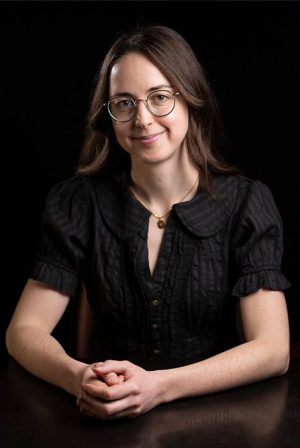
ABOUT THE AUTHOR
Hadley Green is an Emmy-nominated, independent video journalist and documentary cinematographer based in Washington, D.C. Her work focuses on women, gender, LGBTQ+ issues, and sports. From 2021 to 2026, Hadley was a staff video journalist at The Washington Post, where she produced character-driven video stories throughout the U.S. Her photography and video work have also appeared in The New York Times, The Atlantic, WBUR, LAist, and PBS North Carolina. She was a Curve Emerging Journalist Fellow 2025/2026. Hadley is currently directing a documentary film about the first season of the Women’s Professional Baseball League, following player Joely Leguizamon. Follow her on Instagram.