
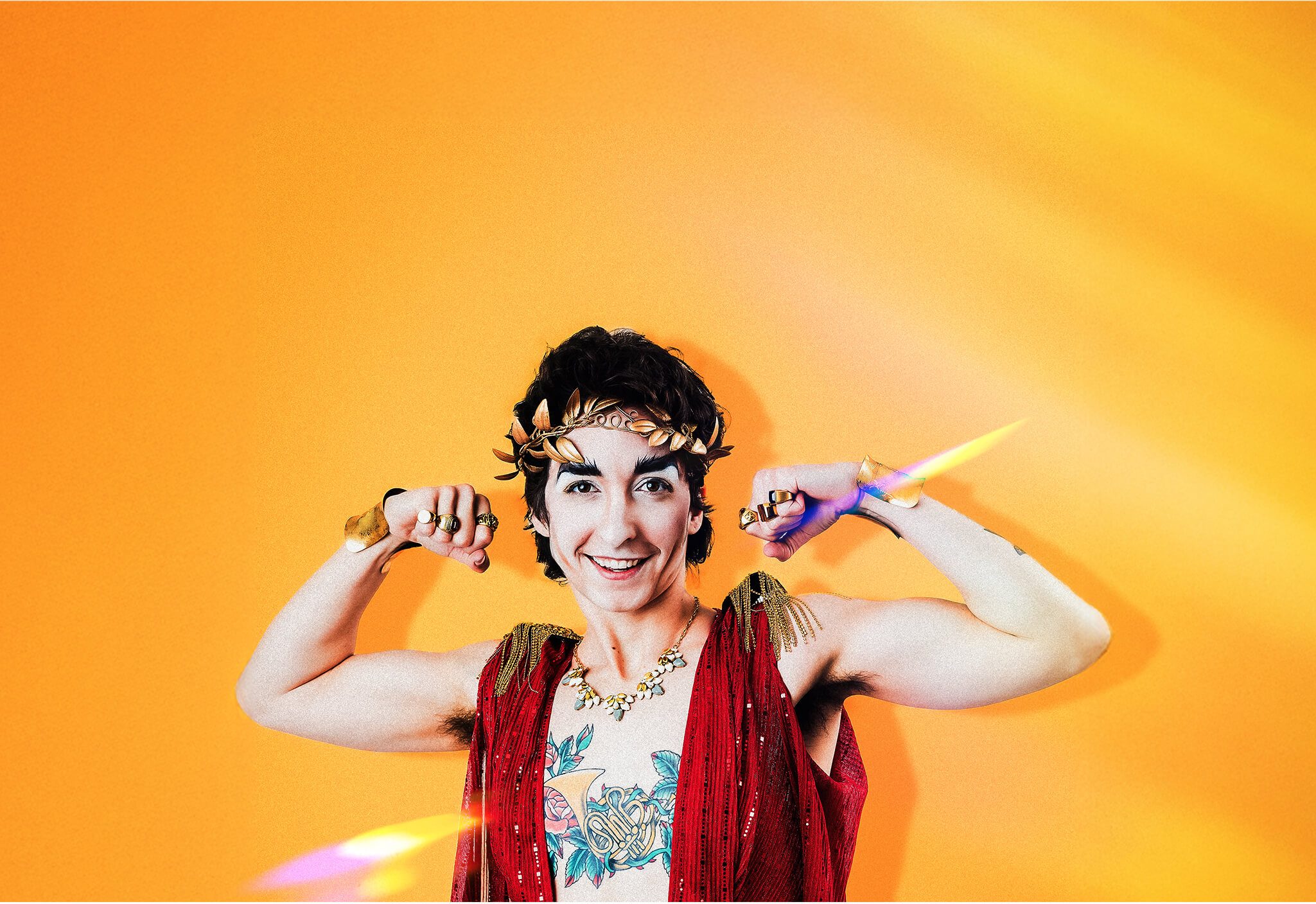
PHOTOS OF DICK VON DYKE: DARIN KAMNETZ
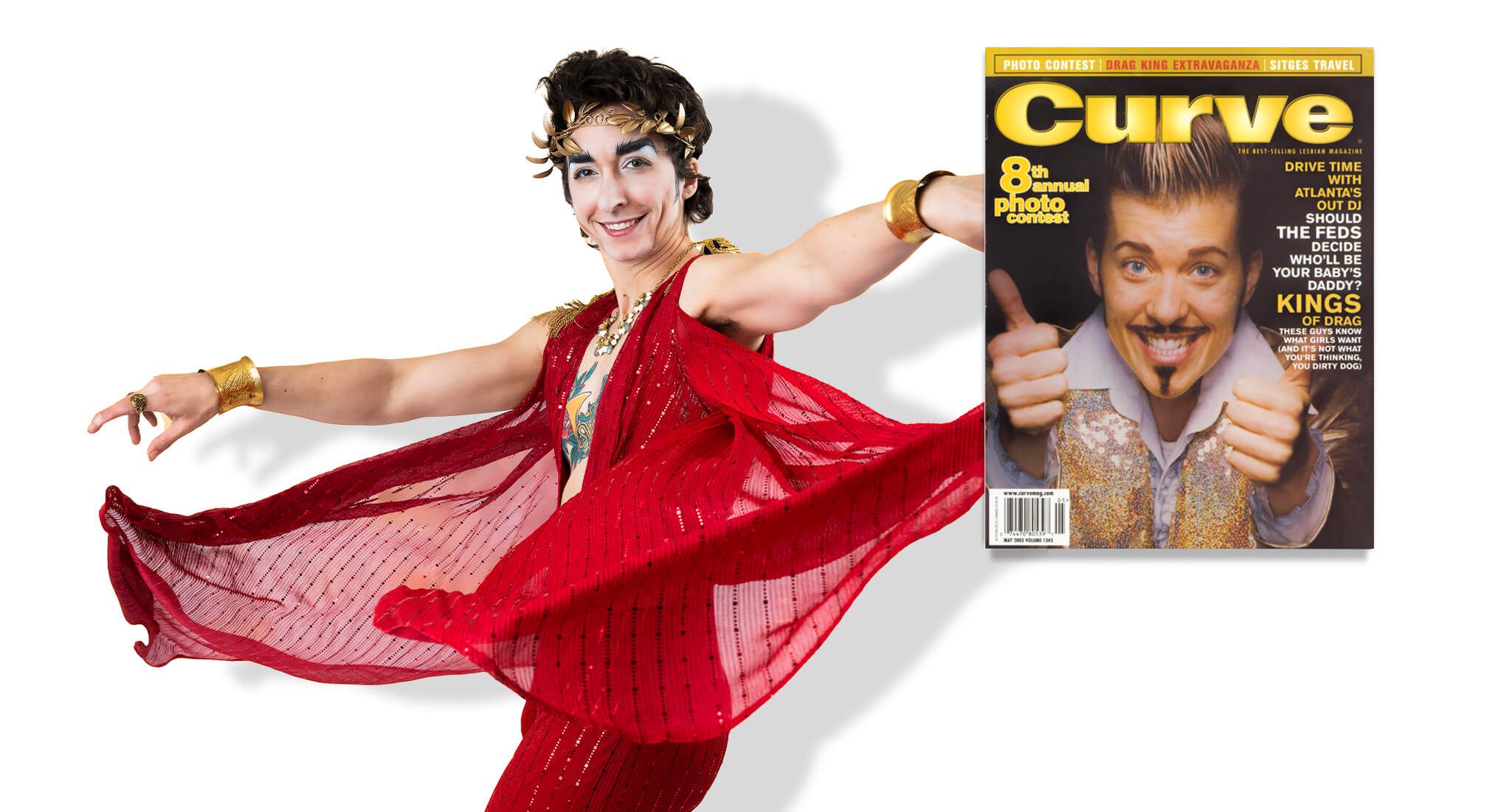
The heyday of drag kings gained significant traction in the 1990s and early 2000s, with scenes in New York, London, Sydney, and San Francisco. In 2003, Curve ran this article surveying the burgeoning drag king scene and some of its key players. And who can forget the gorgeous Kelly Lynch as Ivan Aycock, the gender-bending, courtly drag king in the groundbreaking hit Showtime series The L Word. In popular culture, outshone commercially by their drag queen sisters and the RuPaul’s Drag Race phenomenon, the kings are in the limelight, finally.
King of Drag, the first reality competition show for drag kings, premiered June 22 on Revry, an LGBTQ+ streaming platform. Hosted by drag legend and comedian, Murray Hill, the series features 10 drag kings vying for the title of ‘King of Drag’.
Some of the stellar guest judges include recent Tony winner Cole Escola (Oh, Mary!), TV icon Lisa Rinna, multihyphenate cabaret performer Bridget Everett, legendary drag king Mo B. Dick, Riot Grrrl queen Kathleen Hanna, and comedian Cameron Esposito.
Some of the drag kings up for the crown include the Midwest’s best, Dick Von Dyke, and we caught up with them on the eve of the premiere to find out more.
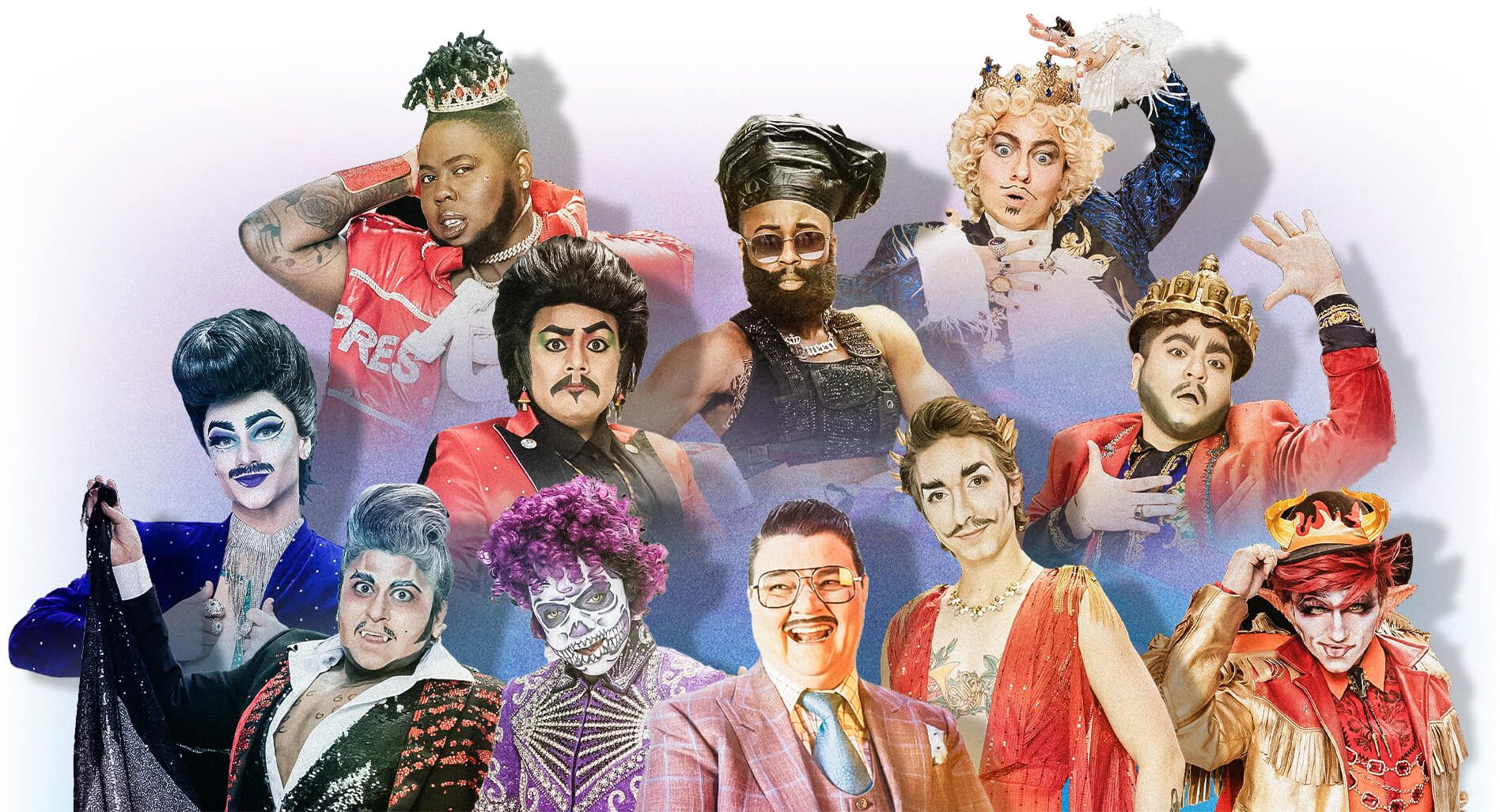
KING OF DRAG CAST — ROW ONE: PRESSURE K, KING MOLASSES, BIG D
ROW TWO: ALEXANDER THE GREAT, CHARLES GALIN KING, TUNA MELT
ROW THREE: BUCK WYLDE, PERKA $EXXX, MURRAY HILL, DICK VON DYKE, HENLO BULLFROG
Can you give us a short background on yourself?
DICK VON DYKE: I grew up in St Louis, Missouri! A city known for its love of baseball, blues music, and toasted ravioli. Not necessarily known for its progressive values. I wasn’t out in high school, and so, like many kids who are uncomfortable with themselves, I marched in the marching band every fall. Music has always felt like home to me; I was raised in a family full of musicians. My family had a reputation at church every Sunday as the family that always either sings in the church choir or plays in the church orchestra. I also grew up watching my dad give “the welcome” in church every Sunday; inviting folks to meet each other and be in community. A lot of time, queer culture and the Church get pitted against each other as polar opposites. But when I get up every Sunday to host drag brunch, it feels like this is exactly what I’ve been trained to do my whole life.
Where are you from? Where do you call home now?
DICK: I’ve lived in Saint Paul, Minnesota, since 2020, and I consider it my home now. I moved here for the drag brunches and the lakes, but nowadays I feel immensely fortunate to live in a state where protections for queer and trans folks are signed into law.
Tell us a bit about how you first got into drag?
DICK: Getting into drag for the first time felt like a release of the ways I’d always been taught that “godly women” have to be…but never saw in myself. Like many Midwestern kids, I was so sheltered from anyone else’s queerness, that I came to the conclusion that there was something wrong with me. God must’ve screwed up. “I must be the only one.” When I started school at the University of Kansas, I’d never heard of drag, or transness, or even Stonewall. I joined the “gay club” at school, and after one of the meetings, one of the folks invited me to pile into their tiny white sedan and go to an 18+ drag show. I had no idea what to expect, but I was instantly mesmerized by the larger-than-life costuming, the way the host got to make everyone laugh, and the black industrial trash bags taped on the windows to keep out the light…and any wandering eyes. I think someone lip-synched to “I’m Still Here” from Follies; someone else did something nasty to the tune of Celine Dion. I was hooked.
In real life, there were trash bags on the windows, but in my eyes, these drag queens were superstars. But they were still…queens. I remember googling “can women be drag queens,” but still not being stoked about wearing a dress. While at home for the summer break, I went out to a drag show at the now-closed “Attitudes Nightclub” in St. Louis and got to see my very first drag king. And he was the emcee! Suddenly, I had a new question to Google. The following semester, I signed up for the student drag showcase at KU. I felt scandalous as I purchased clothes from the men’s section of a thrift store. My girlfriend at the time did all of my makeup because I had never worn makeup before…I had no idea what all the little brushes were for.
The show organizers brought in queens all the way from Missie B’s in Kansas City to be hosts and headliners of the student showcase show. I would’ve never guessed that in just a few short years, these same queens would become my peers; and at some point, I’d even be the one holding the mic. And remember…this was an annual student drag show taking place in Kansas. So every year, the Westboro Baptist Church would mark it on their calendars and protest the show. My first experience of walking down the street in drag was walking past their colorfully catchy lil’ “god hates f*gs” signs.
How did you pick your drag name?
DICK: From the day I was born, I always knew I wanted to be a performer. As soon as I could talk, I was trying to take microphones out of people’s hands…whether at music concerts, at church, or on the Jungle Cruise at Disney World. When I went to pick a drag name, I wanted a name that would nod to both my “why” of wanting to be onstage, as well as honoring my perceived descent into the risque. Mary Poppins was my favorite movie growing up; I’ve known every word to every song since before I can remember. I envied Bert’s costumes…his dance moves…his goofy charm…and that he got to flirt with Mary Poppins. Simultaneously, as a kid, I remember giggling that some guy could have a name that was just two “bad words” with a three-letter connector in the middle. So I decided I also wanted to be some guy.
How would you describe yourself as an artist? Where do you find inspiration?
DICK: I see myself as a goofball who makes art for other goofballs. I’m enchanted by any medium I get to use in order to tell stories that make people laugh, which then makes hard topics easier to approach. Every week, I get to help queer folks feel seen, and let them know that they’re not the only one. That’s what inspires me the most: laughter as a tool to learn and heal. It’s harder for folks to join in on the oppression of queer people once they know our history, and see that certain strategies are being repeated. But in Missouri, like many states, they don’t teach queer history in schools, which is what leaves us vulnerable to hate.
Some of my earliest drag memories are from learning to paint my face while sitting next to drag queens closer to my parents’ age than my own, as they taught me about the history of three-piece laws in St. Louis and how they had to work together to get them changed. A Crystal Waters song blared in the background, cranked up to a volume that hoped to drown out the hum of the dusty AC unit shoved into the window of a black-mold-encrusted upstairs dressing room of a St. Louis gay bar. But it was still a classroom to me.
Why not go into musical theater? Why drag?
DICK: Drag is a unique art form because you can’t get a degree in it. So there’s an accessibility at its core that makes it a safe space for folks to reframe a lifetime of insults and insecurities into this powerfully resilient piece of art. Anyone who’s ever been the butt of the joke in life, suddenly gets to be celebrated for what a great butt they have. If someone calls me “mannish” as an insult, but I’m dressed as a man in a fabulously tailored suit, their insult loses its power. If they say I have a big nose, I say it “adds to my illusion.” If they call me a d*ke, I say “that’s Von Dyke,” to you. In a world where people are making billions of dollars off of dividing us, drag could be a powerful tool in disarming rhetorics that separate us, and transforming them into unity amongst us…if we let it.
Many audiences are familiar with drag queens and not drag kings. Can you share your experience of the importance of supporting kings?
DICK: The fact that platforming drag kings has become this “controversial” idea is disappointing. We’re only in this situation of having to highlight them separately because they’ve been systematically excluded in the first place. And anyway why are we, as queer artists, separating drag by our “junk” in the first place when the heteronormative world is so excited to do that for us? I aspire for a world where we just skip it and make art together! What if there wasn’t one “standard” for what we consider “good” drag? What if gay men in power didn’t continue to perpetuate misogynistic systems of oppression that were used against them? What if we just let artists make art that they like, regardless of gender or expression? I think we’d get better art! Drag kings have been around for centuries; Mo B. Dick has done a great job documenting a lot of it at dragkinghistory.com. I have “drag king” piano sheet music from the vaudeville era framed in my house. Drag kings on TV may be new. But drag kings are not.
What advice would you give to folks who want to try drag for the first time or who are just starting out?
DICK: People ask me this all the time and my biggest advice is… get out there and start! Folks say to me all the time, “I have it almost all the way figured out.” No, you don’t. If you wait til it’s perfect before you start, you’ll never start. Doing it and finding your areas for improvement are how you’re going to continue to grow.
What do you want to see more of in drag spheres? Less of?
DICK: I’ve always seen drag as a way to cast myself in the roles I’ve always wanted to play, and I love to see what roles everyone else would cast themselves in. Sometimes it perplexes me or makes me laugh uncomfortably…but that’s what I love the most! I love drag that gives me a connection to a song I never would’ve otherwise listened to. I love drag that performs to local music! I love drag that makes you cringe to the point where you have to cover your eyes. I love drag that spoofs the patriarchy, rather than reinventing it.
For more information on where to find Dick Von Dyke at upcoming events, go here. For King of Drag on the free channel Revry, go here.