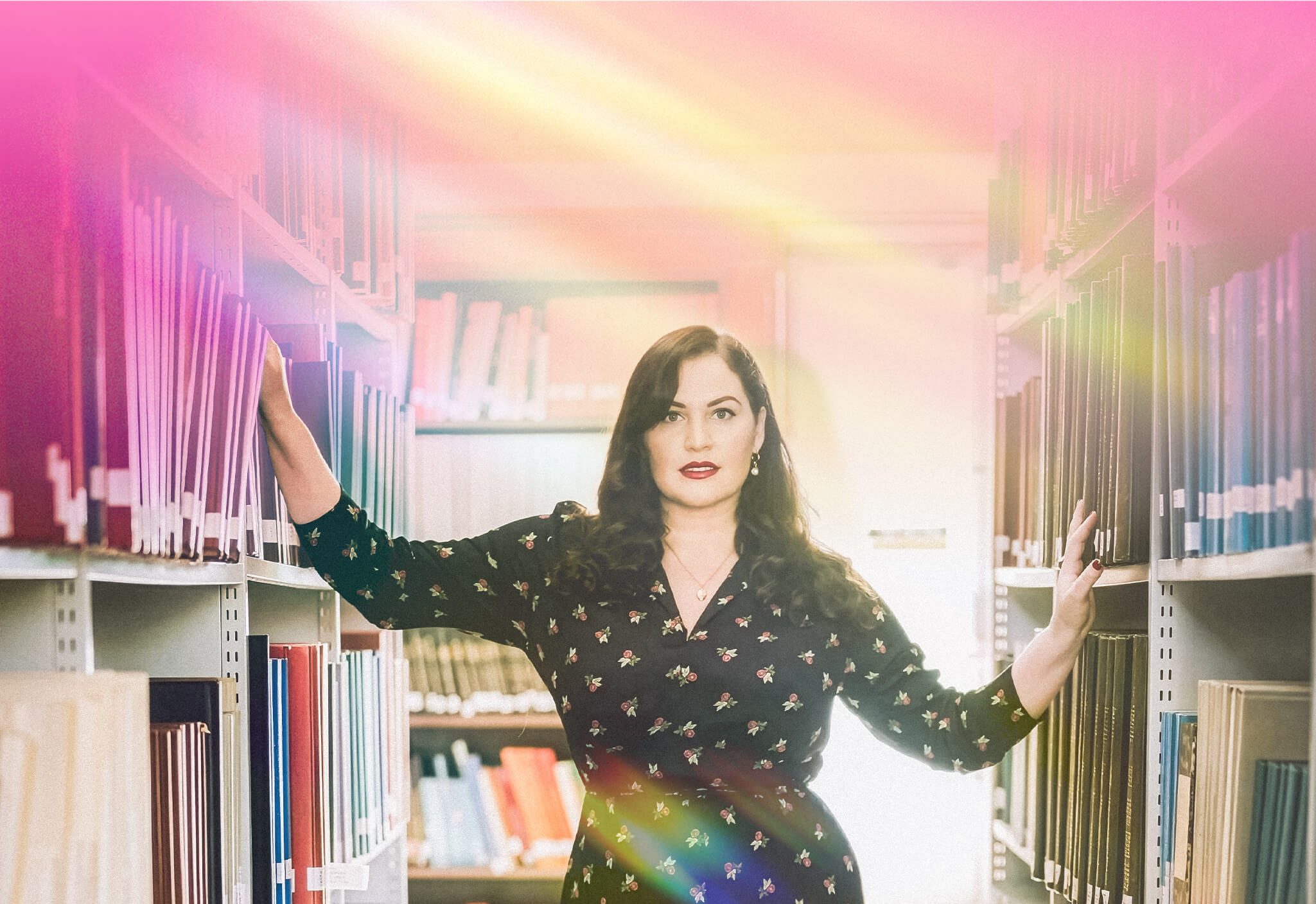
PHOTO: ISAAC QURESHI FOR VADA MAGAZINE
Steering and shaping content for a lesbian magazine is not for the faint of heart. Still, it can be incredibly fulfilling, especially for those of us who discovered our authentic identities through reading magazines like Curve. I was thrilled to finally meet my ink sister Roxy Bourdillion from across the pond, who has been with the U.K.’s lesbian publication DIVA for the past decade, stepping into the shoes of editor-in-chief in 2021. Roxy’s quintessential and quirky Brit voice made for a delightful conversation and partly explains why her memoir is such a ripping good read. After our dialogue, you can dip into an excerpt below and see for yourself!
Merryn Johns: Can you tell us a bit more about how you landed at DIVA?
ROXY BOURDILLON: After many years of struggling to break into journalism while working at soul-sucking office jobs, I was ready to give up on my dream of a creative career. I was going through a tough time, grappling with mental and physical health issues, while grieving the death of the person I loved most in the world. I’d never been so low. Then one day, I spotted an advert for an editorial assistant role at my favorite magazine. I worked really hard on my application, did a ton of preparation for the interview, was immensely nervous because I wanted it far too much, but somehow got the job. Finally, I was a professional lesbian! The job didn’t fix all the other problems, but it did feel exciting to embark on this new queer career at a publication that meant so much to me. I worked my way through the ranks and became editor-in-chief in 2021.
What did lesbian culture look like at the time?
ROXY: In my job interview in 2016, I had to do these writing tasks. One of them involved penning an opinion piece about the TV show The 100 killing off their lesbian character, Lexa. At that time, there was a lot of discourse about ‘Bury Your Gays.’ Looking back, 2016 was a devastating year for many reasons. There was the tragic shooting at Orlando’s gay nightclub Pulse, Trump won the presidential election, and Brexit (Britain leaving the European Union) was announced. It felt like, after a period of relative progress and increased queer and trans visibility, there was this international rise in hostility towards marginalized people, including the LGBTQIA+ community. Bigotry was back, not that it ever really went away.
Where is DIVA at now?
ROXY: I’m pleased to say that after over 30 years, DIVA is still going strong. We have a bi-monthly print magazine, plus the website, social media, and events like the DIVA Awards. Last year, we launched the DIVA Charitable Trust to improve the lives of queer women and gender-diverse people on a more impactful scale than ever.
Do you have any specific memories of Curve magazine from back in the day?
ROXY: I vividly remember discovering it in a U.K. bookshop which stocked international magazines. I was thrilled because Curve gave me a glimpse into lesbian culture in the US, which felt very glamorous, like a real-life L Word. I read articles about iconic American institutions, like Dinah Shore and Olivia Cruises. Every time I got a new issue, I’d read the editor’s letter first, then turn to the agony aunt column, Lipstick And Dipstick!
Do you see a future or a need for lesbian media?
ROXY: Absolutely. I read lesbian magazines long before I felt ready to go to a gay bar or Pride parade. They were a safe, private way to explore my identity. Lesbian media provides a connection to your community while inviting you to understand yourself on a deeper level. That is still needed today, in a world that keeps finding new ways to attack us. I also think that, as queer people, there is something profoundly affirming about the physical act of holding a queer magazine in your hands. Lesbian media will continue to evolve, but I hope it’s here for a long time to come.
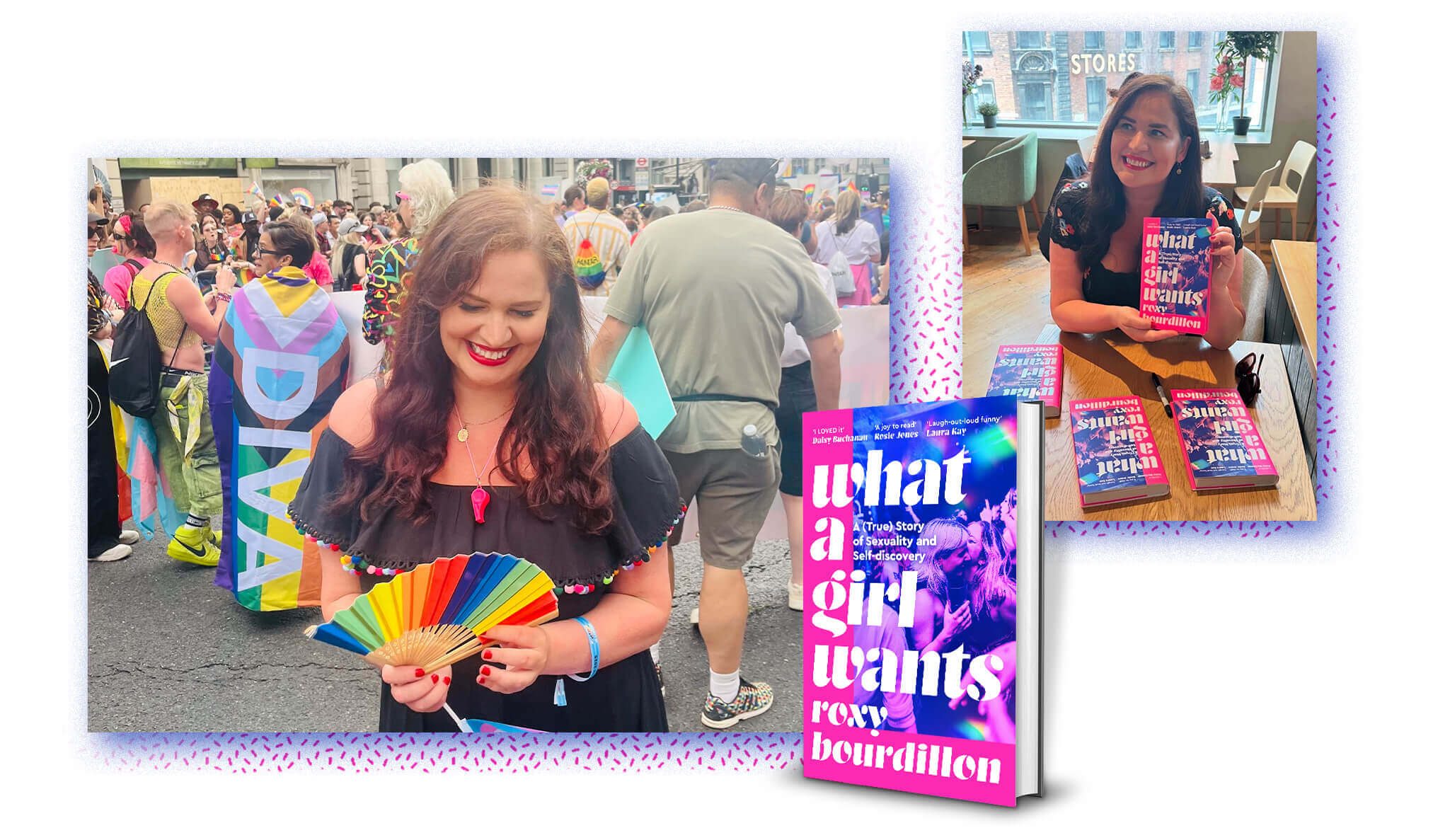
ROXY BOURDILLON AT PRIDE, AND AT A BOOK SIGNING. SUPPLIED BY AUTHOR.
What was the impetus for writing a memoir?
ROXY: I kept thinking about two contrasting points in my life – me at 13, secretly kissing my friend but still closeted and drenched in shame, and then me in my 30s, an out and proud woman who has made a whole career from writing about, to use the technical term, gay stuff. I was interested in that journey of going from one extreme to the other, navigating the challenges of life as a woman who happens to really, really love women, in a world that can make you feel terrible about both of those things. I wanted to dive into all these rich topics – body image, mental health, love and loss – through an inclusive, feminist, lesbian lens. Most of all, I wanted to write something funny, warm, and true. I hope this memoir is all those things.
How hard or easy was it to get a book deal?
ROXY: I’d been sitting on this idea for a couple of years. I knew I had a compelling concept, but my work at DIVA was so all-consuming I didn’t have any spare energy to plough into my own book. Then one day, I was approached by Jodie Lancet-Grant, a wonderful book editor at Bluebird, Pan Macmillan. A fan of my writing, she asked if I’d ever considered doing a book. I pitched my idea and she loved it. After I put together a proposal and sample material, I was offered a book deal. I started talking to literary agents and clicked with the brilliant Laura Macdougall at United Agents. As well as being super-talented, Jodie and Laura are both queer women. That feels special and significant, because I know they relate to my writing and understand the urgent need for more lesbian stories.
Do you see any other major similarities or differences between U.S. and U.K. lesbian cultures?
ROXY: In my experience, there are more similarities than differences. DIVA is part of the Queer Women’s Media Coalition, founded by Curve’s very own Franco Stevens. When I speak to incredible queer journalists in the US, I’m struck by how much we have in common, from shared cultural touchstones like The L Word and Janelle Monáe, to how passionate we are about trans rights.
As lesbian editors-in-chief, we hold space open and predict the future. Fast forward 100 years: Will we still have a lesbian community and media? What will it look like?
ROXY: I love this idea of editor-in-chiefs as magical, future-telling beings! Okay, so it’s the year 2125, and naturally, Curve and DIVA are still thriving, celebrating – what – issue number 1000?! Seriously, we might express our identities in different ways, and our language will have
evolved. I dearly hope our rights will have progressed too, and that we will have equality for everyone in our beautiful, diverse community. But the part I’m sure about is this: I believe that lesbians, queer women, and gender-diverse people will still be here. We have always been, and we always will be.
Excerpt from Chapter 5:
Talking, laughing, loving, breathing, fighting, fucking
I tell nobody, not even Dylan, about the new crush that is consuming me. Her name is Kiara and I swear, when we’re together it’s like the air is throbbing. I’m honestly not sure what it means at first. I am that naïve. She is gorgeous. Ebony hair and dark, intense eyes. We laugh the whole time, but there’s also this feeling, an unfamiliar forcefield that fills up whatever room we’re in.
Then one day I’m hanging out at hers. We are sat on the bed together while I style her hair. As always, there is an energy between us, a crackling, confusing attraction. We go quiet for a moment and then she says suddenly, ‘Can you feel it?’ We both laugh, nervously, self-consciously. This feels absurd, dangerous, exciting. She leans in towards me, then stops herself abruptly and says incredulously, ‘Oh my god, I was going to kiss you.’ When I finish doing her hair she asks if I want her to do mine and this sounds crazy, but it feels almost like a sexual invitation. I’m so overwhelmed I make an excuse to leave.
The next time we see each other the electricity is still in the air. We laugh, then we freeze. ‘Can you still feel it?’ I ask.
‘Yes,’ she says. Then she suggests we get together the following night and talk about what’s going on, because we can’t carry on like this.
When she comes over, my nervousness is ricocheting around my room. We knock back a three-quid bottle of Australian red from the corner shop at breakneck speed. I genuinely believe that our appointment is to discuss how we’re going to alleviate the tension between us. But I am hammered and she is gorgeous and suddenly we’re kissing. Our bodies press against each other, our hungry mouths can’t get enough.
When we sleep together, it is a revelation. It is intense and intoxicating. There is a moment during this first time with another woman when I clearly think to myself, ‘Oh, this is what sex is supposed to feel like. This is how I’m supposed to feel when I have sex with someone.’ And it’s the first time I’ve ever had that thought.
Once the seal has been broken on our magnetic attraction, we have many more nights together. We tell nobody what we’re doing. I’m not ready to detonate my life by coming out and neither is she. Something’s starting to flicker in my mind, though. A one-off sapphic romance might have been a fluke, but now there’s a reboot called Secret Sapphic 2: The Undercover Lez Strikes Back. Call me crazy, but is something going on here?
*
It’s around this time that I meet a woman who will change my life forever. Her name is Bette Porter.
So I’m back in Leeds between terms, stealth-watching The L Word in my teenage bedroom. The L Word is the most famous lesbian TV show ever made. When Ilene Chaiken’s LA drama premieres in 2004, it marks a new era of representation, putting queer women front and centre.
I’ve locked my door, but the volume is still turned right down. I’m both terrified of being caught and extremely turned on. It’s the TV equivalent of a danger-wank. I can’t believe what I’m seeing. Lesbians! En masse! On the telly! Usually on the rare occasion you
do spot a gay lady on TV, she is the only one, a lesbian lone wolf in a sea of straights. I’ve seen queer women together very occasionally in Bad Girls or Tipping the Velvet, but the characters in The L Word are something entirely different. They aren’t from the distant past or locked up in prison for their sins. These are contemporary, free-range lesbians. I am immediately and irrevocably obsessed. I fancy them all. What is this brave new world?
Mine is not a unique experience. Queers everywhere are watching the show and feeling something they’ve never felt before. They feel, we feel, instantly less alone.
As I keep watching, my eyes are drawn to Bette Porter, played by Flashdance star Jennifer Beals. Bette is exquisite, always wearing an impeccably tailored trouser suit, always making a slightly inappropriate, impassioned speech. She is indifferent to men and addicted to seducing women. Part of me wants to be her and a much bigger part wants to be with her.
Also, not to state the obvious here, but The L Word is just so gay. They’re always talking about exotic concepts like ‘lesbian bed death’ and ‘big old lezzy tennis players’. I learn all the words to the iconic theme song: ‘Talking, laughing, loving, breathing, fighting, fucking . . . ’
Characters keep giving really specific lesbian advice and I’m taking copious mental notes: ‘If you don’t have bush confidence, you won’t feel good about your bush and you will never get laid.’ Got it, embrace your bush or no one else will.
‘What do lesbians bring on a second date? A turkey baster.’ I’m not much of a chef, but I dunno, I’m feeling pretty pumped right now. Maybe I can get one at Sainsbury’s!
‘If your ring finger is longer than your index finger, it means you’re a lesbian.’ Sounds bogus, but lemme quickly check. Holy shit imaginary L Word friends, I have Gay Finger!
The L Word is a portal to a parallel universe. It offers this sense of possibility, a blueprint for a way of being that I couldn’t have fathomed before. Could this be my life? Could I be a lesbian art world mogul with a wife and a gang of cool queer pals, who goes to girl parties called Twat: The Night?
The show’s impact on me doesn’t end once the episode stops playing. The L Word acts as a gateway to a whole new community I have never experienced before, the community of fandom. I devour blogs about the show and watch YouTube supercuts of the best (AKA steamiest) scenes. I read in astonishment about viewing
parties in the US and imagine being in a bar full of women who love The L Word as much as I do. The first ever podcast I listen to is The Planet, where KC and Elka, two superfans from Albuquerque, dissect each episode in minute detail. I visit fan site thelwordonline.com and am staggered by the messageboards filled with page after page of comments lusting after androgynous heartthrob Shane McCutcheon, trash-talking divisive baby gay Jenny Schecter and, most
mind-blowingly of all, flirting outrageously with each other. What is making my brain explode is the fact that these comments are from actual living, lezzing people. This isn’t just about characters on TV any more. These are real women-loving women in real life, bloody loads of them.
The L Word is the shared sacred text and it’s suddenly giving all these far-flung queer women a common language. Online, I discover hundreds of viewers whose lives have also been transformed by the show. The internet, still a relatively recent innovation, is facilitating a whole new way for disparate LGBTQIA people to find information and each other. I don’t comment on any of the messageboards. I’m not ready for that. But I know they’re all there now. I know there are so many of them, all around the globe. It’s as if in one instant the pitch- black night sky is lighting up with a thousand stars and they’re all like me. We are legion.
While discovering The L Word is largely a euphoric experience, it does perhaps lead to slightly unrealistic expectations about what actual lesbian life is like. After watching the show, I go to a lesbian bar for the very first time.
Expectation: I will instantly be befriended by a posse of shimmering power dykes who will clasp me to their metaphorical, and hopefully literal, bosoms. We will bond over our shared ‘bush confidence’ and then probably become embroiled in a complicated yet exhilarating tangle of sexual intrigue. Sounds gay, I’m in.
Reality: After weeks of psyching myself up, getting nervous, then excited, then nervous again, I enter the bar with apprehension. I’m alone. I would never normally have come to a bar by myself, but I’m on a reconnaissance mission, and just maybe I’ll meet some new amazing lesbifriends. ‘All The Things She Said’ by t.A.T.u. is blasting on the stereo. I feel self-conscious, out of place, even though surely this is a place where I should feel like I belong. It’s not that busy, but there is a trio of women, laughing loudly. One of them looks a bit like Shane, with her messy cropped hair and studied air of being too cool to care. I’m too scared to say hello to anyone, so I order a Smirnoff Ice, scurry to the nearest corner and down the alcopop in silence. I sit. I sweat. I can’t take this anymore. I start pantomiming as if I’ve just this second remembered that I have an urgent appointment I simply must get to immediately. I beat my hasty retreat, alone, no power dyke posse in tow.
Nevertheless, The L Word sparks something in me and I want more of this feeling. What school didn’t teach me I’m having to figure out solo, so I find myself on a quest. An undercover sapphic quest of epic proportions. My mission? To gather as much data on ‘lesbians’ and ‘lesbianism’ as possible, in an attempt to (a) understand my own sexuality, and (b) find new beauties to lust after. I’m so jazzed about this voyage of discovery! I bet I’m going to strike lesbian gold! Look out lezzies, I’m coming for you!
***
What A Girl Wants: A (True) Story Of Sexuality And Self-discovery by Roxy Bourdillon is published by Pan Macmillan and is out now in hardback, e-book, and audiobook, read by the author. Purchase the book here:
ABOUT THE AUTHOR
Growing up as a closeted teenager in England, Roxy secretly read DIVA, the iconic U.K. magazine for queer women. Many years later, after finally coming out, she landed a dream job at the publication. Since Roxy became editor-in-chief, DIVA has gone from strength to strength, celebrating multiple sell-out issues and winning the ‘Trans In The City’ Award For Trans Inclusive Organisation, while Roxy herself was awarded Highly Commended New Editor Of The Year by the British Society Of Magazine Editors.
Roxy’s writing has appeared in Cosmopolitan, Glamour, Curve, LOTL, The BBC, and more. An experienced journalist, she’s interviewed stars including Emma Stone, Ruby Rose, and the cast of The L Word, co-hosted a podcast alongside Rachel Shelley (aka Helena Peabody), and presented a special documentary for Virgin Radio called Butches, Femmes And Dykes Snogging On The Dancefloor: The Incredible True Story Of Lesbian Nightlife. Roxy’s groundbreaking work in media has earned her a place in both The Guardian’s Pride Power List and the Attitude 101: LGBTQ+ Trailblazers Changing The World. Follow Roxy on Instagram @roxybourdillon and visit roxybourdillon.com.